

Michael Moore
Integrative Biology
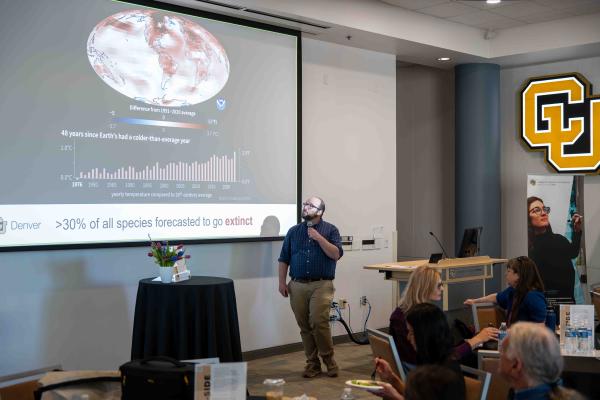 Michael Moore opened with a warning: we already know climate change could drive up to 30% of the world's species extinct, but his research suggests that number may be a serious underestimate. The reason is reproduction. Moore's lab studies what he calls the "reproductive meltdown"—the way rising temperatures disrupt breeding long before they kill adults outright. Even modest heat can render animals sterile, make offspring nonviable, or simply push individuals away from breeding grounds so mates can't find each other. Survival, in other words, doesn't guarantee the next generation.
To study this in the wild, Moore's lab uses dragonflies, particularly species whose black wing pigmentation—used to attract mates—absorbs so much heat that males sometimes abandon mating just to cool down. Working with PhD student Sarah Nalley, Moore analyzed over 600,000 citizen science observations across 60 species since the 1980s. The findings were stark: ornamented species have already lost 30% more historical habitat than non-ornamented ones, and projections suggest that gap could quadruple by 2061. The same pattern plays out in crabs, lions, beetles, and more. Unless scientists account for reproductive disruption, Moore argues, we will keep underestimating the peril that wildlife faces right now.
Vanessa Navarro-Rodríguez
Political Science
 Vanessa Navarro-Rodríguez studies a deceptively simple question: when governments extract natural resources from indigenous territories, what happens to how those communities see themselves —and their relationship to the state?
Her research focuses on southern Chile, the historical homeland of the Mapuche, Chile's largest indigenous population. After the Pinochet dictatorship, government policy subsidized the planting of non-native pine and eucalyptus on ancestral Mapuche land. By 2013, the state had invested nearly $875 million in the industry, with roughly 70% flowing to just two private companies. Using survey data, administrative records, and fieldwork interviews, Navarro-Rodríguez found that municipalities with heavier forestry concentration have higher concentrations of Mapuche people who do not identify as Chilean—and greater rates of both nonviolent and violent political mobilization.
The reasons are material and historical. Forestry plantations deplete groundwater, acidify soil, and increase wildfire risk, with little state regulation. For the Mapuche, who weren't colonized until the late 1800s, this echoes the dispossession of living memory. Navarro-Rodríguez argues the pattern extends far beyond Chile: across settler colonial states including the U.S., Canada, and Australia, resource extraction on indigenous land is reshaping who feels willing—or able—to belong to the nation.
Anna Warrener
Anthropology
 Anna Warrener's research career started with a question she asked a professor shortly after having her first child: is it really true that women walk and run less efficiently than men because their pelves must be wide enough to give birth? The professor's answer—"that's the story, but nobody has actually tested it"—became the foundation of her dissertation and the next decade of her work.
The theory she set out to test is called the obstetrical dilemma, proposed by anthropologist Sherwood Washburn in 1960. Washburn argued that the female pelvis is an evolutionary compromise between the narrow shape needed for efficient walking and the wide shape needed to birth large-brained babies. Textbooks codified this idea for generations. Warrener's data told a different story. Using motion capture, ground reaction force measurements, full lower-body MRIs, and oxygen consumption data, she found no correlation between pelvic width and locomotor efficiency—and no difference in walking or running costs between women and men in her sample.
Rather than simply debunking the old model, Warrener has proposed a replacement: the "multi-factor pelvis," a framework that accounts for the full range of evolutionary and developmental forces shaping pelvic anatomy, and that she hopes will generate better science—and remove the stigma of treating the female body as poorly designed.
Nicky Beer
English and Creative Writing
N icky Beer's poems often begin in museums. She walks, she looks, she takes notes—and eventually those notes become a first draft. Her latest started with a crease.
In August 2024, Beer visited the Art Institute of Chicago and stood in front of Toulouse-Lautrec's At the Moulin Rouge. At a certain angle, she could make out a faint rift in the canvas near the green-faced woman at the painting's edge. Research revealed why: at some point, likely because the woman's strange appearance made the work hard to sell, she had been cut out of the painting. She was restored in 1914. The woman was May Milton, a performer in the Parisian demimonde, possibly a lover of the iconic entertainer Jane Avril—and largely forgotten by history.
Beer shared the resulting poem, inhabiting Milton's perspective—her strange green gaze, the lurid reef of the Moulin Rouge behind her—and reclaims her from erasure. Beer connects this to the broader tradition of queer ekphrastic poetry: stepping into the civilized spaces of galleries and history, and insisting on the lives, desires, and identities that have been hidden, cut away, or simply never named.
Jim Grigsby
Psychology
 Jim Grigsby is not the kind of researcher who follows a straight line. His career has wound through clinical psychology, VA hospitals, telemedicine, stroke research, and a previously unidentified genetic disorder he helped discover—before arriving, somewhat unexpectedly, at one of medicine's most contested and promising frontiers: psychedelic-assisted therapy.
His introduction to psychedelics came early, during graduate work at the University of Saskatchewan, near the site of some of the world's first clinical psychedelic research. His more recent involvement came through a chance conversation with a therapist, which led to an MDMA study, which led to four attempts at NIH funding, which finally led—with colleague Dr. Stacy Fisher—to a funded study of psilocybin for existential distress in late-stage cancer patients. Data collection is nearly complete, and while results can't be unblinded for about another year, Grigsby noted the early signs are encouraging.
That work has anchored a new psychedelic research center at CU Denver, pursuing philanthropic and federal funding to study applications including chronic pain, traumatic brain injury, stroke rehabilitation, Parkinson's disease, PTSD, and couples therapy. With Colorado and now federal attention turning toward ibogaine research as well, Grigsby's center is quietly becoming a hub for one of the most rapidly evolving areas in modern medicine.