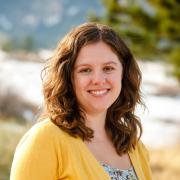

For Emily Hecker, graduate school was never about pursuing academia for its own sake. From the beginning, she was looking for practical tools and real world application. That is what led her to CU Denver’s MA program in Anthropology. “The fact that the degree was clearly labeled as applied was a huge draw for me,” she explains. “I knew I wanted to work in communities and organizations, not stay in the university longterm.” Living in Denver at the time made the transition seamless, but her academic interests were equally personal.
With close family and friends who are immigrants from Latin America, she felt especially drawn to medical anthropology and to faculty working on immigrant health. That alignment between lived experience and scholarly focus made the program feel like the right fit. During her time in the MA program, Emily concentrated in Medical Anthropology with a secondary focus in biological anthropology. She pursued a Latino Public Health certificate, which required a capstone project. Through that experience, she partnered with a Denver nonprofit that ran a diabetes prevention program for immigrant communities. Over the course of a year, she conducted a program evaluation that assessed how the initiative was functioning and where improvements could be made. That project foreshadowed her career path.
Today, Emily works at the CU Denver Evaluation Center, where she supports nonprofits and community organizations through research and evaluation. Her day to day responsibilities include designing data collection tools, conducting interviews and focus groups, analyzing qualitative and quantitative data, and writing reports that help organizations secure funding and improve services.
Looking back, she sees her anthropology training as the backbone of her work. “The research methods were huge,” she says. “I do qualitative data collection and coding all the time. That foundation made everything else easier.” She also credits the program with shaping how she thinks about bias and reflexivity. Understanding that data analysis is never neutral and that researchers bring their own perspectives to the work continues to inform how she designs evaluations.
One of the most distinctive contributions anthropology makes to her field is its attention to narrative. In evaluation work, there is often pressure to focus on numbers alone. But Emily emphasizes that individual experiences matter. “In anthropology, you learn how powerful one person’s story can be,” she explains. “In evaluation spaces, people sometimes overlook that. But those stories can completely shift how you understand a program’s impact.” She has worked to integrate that perspective into her team’s approach, showing colleagues how qualitative insights complement statistical findings.
For Emily, strong evaluation blends both.Translating a degree in medical anthropology into the professional world sometimes requires explanation, but she has learned to frame it clearly. In grant proposals and professional biographies, she describes her training as rigorous social science research grounded in both qualitative and quantitative methods. Once collaborators understand the methodological depth behind the degree, its relevance becomes clear.
For current MA students, Emily offers practical advice. She encourages graduates to explore evaluation roles in nonprofits, foundations, and community based organizations. Many positions include responsibilities related to data, program improvement, and reporting to funders.Anthropology graduates, she argues, are often already equipped with the analytical and communication skills these roles require. “There’s a big need for people who can use data to show why programs matter,” she says. “Anthropology prepares you for that, even if you don’t realize it at first.” Her own journey demonstrates how an applied anthropology degree can translate directly into meaningful, community oriented work. For Emily, the value of the MA lies in the ability to move between research, collaboration, and impact. Anthropology, in her view, is not confined to the classroom. It lives in the way programs are evaluated, stories are told, and communities are supported through thoughtful, evidence based practice.