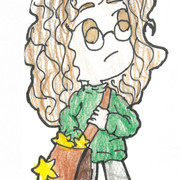

Lyn graduated from CU Denver in 2016 with her BA in Literature and Creative Writing. Naturally, she died from this and continues on at CU Denver as a diligent ghost. She has worked in a semi-solid state at the Writing Center for more than two years. During this time, she has snuck up on people who teach business and science writing, learning how to apply her skills to multiple genres. Writing on film is her favorite, of course, because she’s a ghost and films are filmy. Also, her killer BA is rife with literary and film analysis. A highlight of her solid life was attending the Telluride Film Festival Student Symposium. Lyn believes that all writing is in a state of flux, which she finds empowering. She moans queasy words of encouragement like, “Revision is your forever friend!” to students every day.
Lyn's Consultant Philosophy
Writing can create a vulnerable space. While writing is an organic process, it is also fraught with concerns about others' judgment and a fear of permanence that is nearly impossible to quantify. Because of this, writing becomes a psychological and emotional process, not just a technical one.
I believe there are universal experiences in writing, but I want to honor the student’s individual experience before getting them to see their process in a global context. For me, this is when tutoring becomes guidance, not just teaching grammar or structure. Rather like a guide in a national park or museum, I explain the writing territory or display to an individual and help them see their relationship to this environment. Students need to trust their guides, not just for their expertise, but also for how they respond to the work being done in session. I work to create a space, online or in-person, where trust can be built.
Active listening is key to creating that trust. I make sure to frame my responses to students in terms of what I have heard them saying by repeating or phrasing their input in my own words. I prompt further discussion through open-ended questions that generate ideas they can feel themselves producing. Then, I want to give them the space to recognize this as progress. When the student can write something based on our conversation, they can recognize that this is useful progress.
Inevitably, I want to strive in session to get the student to hear their own voice. Often their expectations are to produce the artificial academic voice that plagues all their research. Guidance in tutoring helps the student understand their own authorial agency, which necessarily will grow through stages of practice, immersion, and listening. When a student is heard, it validates their ideas and gives them the confidence to continue to strive toward clarity.
I understand that independence from the tutor is an ultimate goal, but I am not sure, philosophically, how much I buy into that. I believe a student seeks guidance because they need help. Asking for help is a skill, not a vulnerability itself. I hope the student understands that I, like the Writing Lab, am just one source of help. I talk to students about what I might be an expert at explaining, while other consultants could be helpful with different problems. I want to make sure they understand research resources and who could guide them in these spaces. Career centers have important connections to the types of writing they will need to do. All writers need an audience and feedback, and this means they need the ability to ask for it. I hope to be a good foundational experience for their audience.
I want a student to come away from a session feeling capable of writing. If they come in feeling capable already, I want them to feel motivated by their ability. I believe both are a way of owning the writing process.
(Last update: 11/26)
Lyn's Illustration