
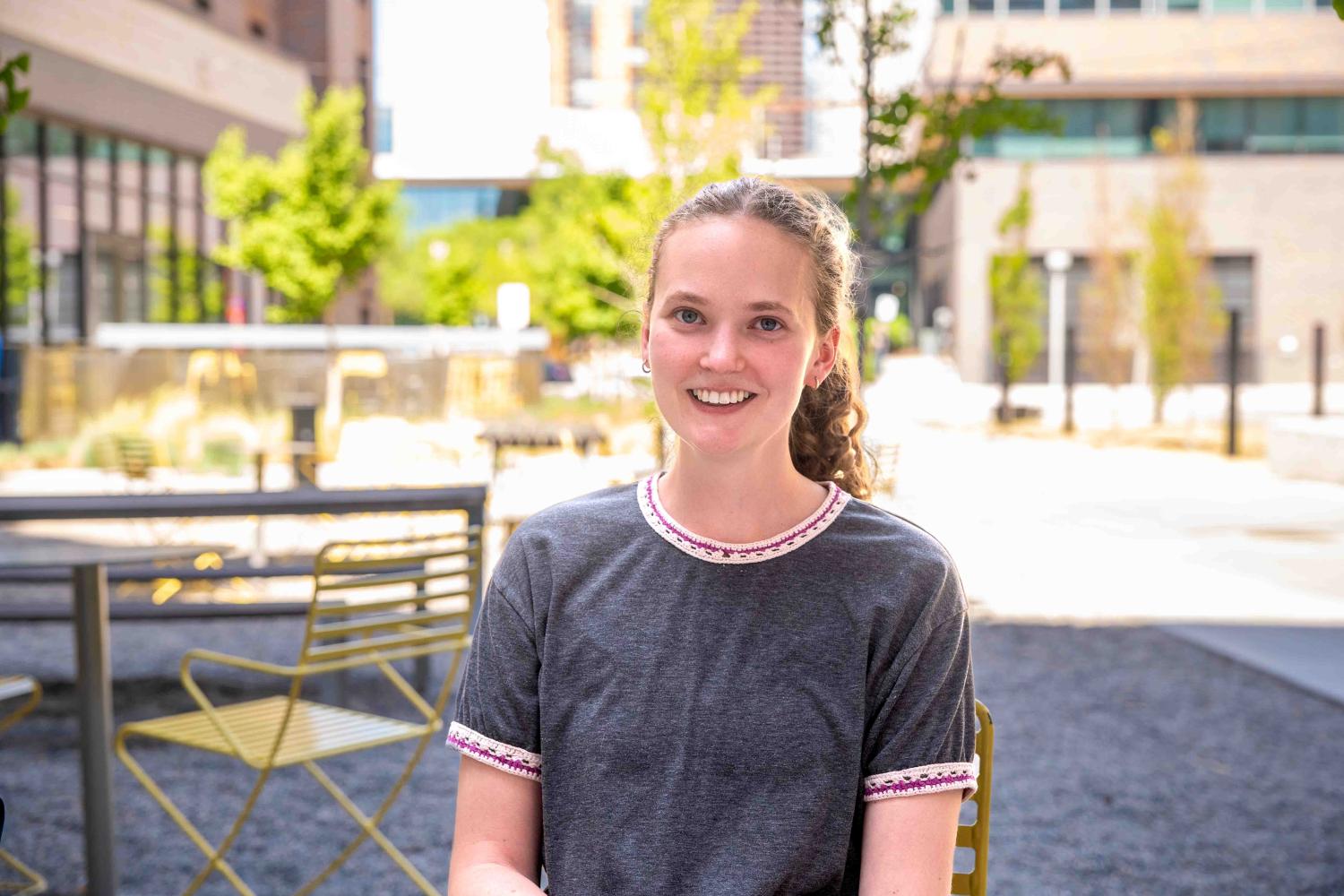
Martha Young spent her summers chasing dragonflies across Colorado. What she found might change how we understand climate change — and ourselves.
When Martha Young walked across the stage to receive her Master of Science in Integrative Biology from CU Denver this May, she’d logged more than 3.5 hours of driving from the lab to her field sites every other day for an entire summer, listened to nine audiobooks, plodded into ponds in waders, and raised hundreds, if not thousands, of dragonflies and damselflies in kiddie pools and habitats both at the foot of and in much higher elevations of the Rocky Mountains — all in pursuit of answering a question most would never think to ask.
What happens to an organism when the world it was born into starts to change?
"I've always just wanted to go around and look at weird animals and pick up weird animals and think about weird animals," she laughed. "That has always sounded like the dream."
For Martha, her dream came true through science.
Little Creatures, Big Questions
Young's path to CU Denver began, as many good things do, with something unexpected. During her undergraduate experience at William & Mary, she found herself captivated with her field research on freshwater jellyfish — a detour that crystallized something important.
"I realized I really enjoyed research she explained. "And I wanted to keep learning about wacky little creatures that people don't think about very often."
That curiosity led her to the lab of advisor Dr. Michael Moore, whose work on climate change and insect physiology felt like a natural home.
"I pretty much came here because of both his research and him," she noted. "The department is pretty small, and close-knit. I was looking for somewhere I could learn more about myself and about biology."
She found both.
The Slowest Migration
The premise of Young's research starts with a well-established conceptual dilemma: Earth’s climate is warming, and animals need to adapt.
As temperatures continue to rise, many species are expected to shift upslope — moving to higher elevations where it's cooler. But scientists have found this is happening far more slowly than predicted. Young wanted to know why.
"As you move up a mountain, it's not just the temperature that changes," she stated. "It's also windier. The sun is brighter. There's more UV radiation. There's less oxygen. You're huffing and puffing on your hike — and these are environmental conditions that animals have to face too."
Her hypothesis: harsher conditions might be acting as a barrier, making it difficult for animals to adjust successfully at high elevation. To test it, she designed what's called a reciprocal transplant experiment by collecting dragonfly and damselfly larvae from local ponds, then raising them at two different sites: one low, one high.
Watch Martha's Interview
Elevation Documentation: Martha’s Surprising Research Results
What Young found upended the assumption that high elevation is simply too harsh for these animals.
"It seems like there actually are differences in development depending on elevation," she observed. "And interestingly, each group had plasticity for the traits that matter most to them."
Damselflies, which are sensitive to cold and have a difficult time regulating their own body temperature, developed darker colors — enabling them to absorb more light and heat, thus warming themselves more easily in the chillier, high elevation environment. Dragonflies — intense, territorial fliers with enormous oxygen demands — became better at flying in low-oxygen conditions when nurtured in their high elevation home.
The mechanism behind the dragonflies' improved performance is still an open question — but the leading hypothesis is a fascinating one.
"Insects breathe in a really silly way," Young detailed. "They have what are called trachea — basically holes in their exoskeleton that go directly into their muscles. They don't have lungs. It's just air going into these little holes, and the oxygen and CO2 flip flop."
Previous work from her lab has found that high-elevation dragonflies tend to develop larger, more intricate tracheal systems — building more pathways directly into their flight muscles so they can pull in more oxygen precisely where they need it. Young suspects something similar may be happening in her individuals, but she didn't directly measure tracheal density in this study, so the picture isn't yet complete.
"So, it seems like moving upslope might not be as big a barrier as we thought," she summarized. "During development, they kind of regroup and figure it out."
The View from the Mountain
For Young, none of this work exists in a vacuum.
"Climate change was something I was kind of brought up thinking about through my family," she mentioned. "It's always been something I'm passionate about — something where I'd like to make even a very small, hopefully good impact."
But she's clear-eyed about how science actually reaches the people who need it. Publishing a paper isn't enough.
"A lot of times scientists finish their work, write their paper, and feel like that's all they need to do," she added. "But people who aren't in the field aren't seeking out scientific journals — and those papers are often written in a way that's really difficult for everyone else to follow. If you can communicate your science in a digestible way for the public, that's probably the best thing you can do."
From Mountain Tops to the Front of the Classroom
It's a philosophy she lives out in the classroom, too. Since arriving at CU Denver, Young has acted as a Teaching Assistant, instructing introductory biology labs — and the experience transformed her as much as any experiment.
"I had no experience talking in front of a group of people before," she remarked. "Getting the confidence to stand up in front of a room, even when you're not the ultimate expert on what you're teaching, has been such a lovely experience."
She gushed about her students with fond memories and authentic warmth.
"So many students at CU Denver are just incredibly lovely, fun, smart, and capable. I have really loved working with them."
Ask Questions. You Are Not Alone.
Like any researcher, Young has had her share of gaps in her knowledge — concepts she had to refresh herself on before teaching to her students, questions she couldn't answer on the spot. Her strategy: over-prepare and stay honest.
"When you're starting out in a program like this, everyone around you seems so incredibly smart and amazing, and you get into the space and you don't understand anything anyone's saying. That can really bring up feelings of imposter syndrome — feelings like, 'This isn't the place for me. How did I get here? Did they switch up the applications?'"
She paused.
"But that's honestly how so many people feel. Any single person you ask has felt the exact same way at some point. Whatever new scary thing you're starting, everyone else has also started a new scary thing. They've also been scared. You are for sure not alone in that."
Martha’s Next Move
Young has accepted a position teaching physiology at the University of Minnesota Rochester — a role she found out about just before sitting down for this interview.
"I accepted yesterday," she beamed, barely containing it. "So this is all very exciting news and I cannot contain it."
She's also drawn to the department's focus on biology pedagogy — the science of how people learn and how teachers teach.
And if the future is still a little open-ended? She's okay with that.
"People keep telling me I have a lot of time left and I can do so many things. I'm honestly just excited to see what I end up doing."
The dragonflies, after all, didn't know what the mountain would ask of them. They just went. And when the conditions changed, they found a way.
So will she.