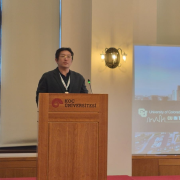
Denver, CO – The University of Colorado Denver is proud to announce that Dr. Scott Reed , a CLAS faculty member and researcher in chemistry and molecular informatics, has been awarded a prestigious Fulbright Specialist Program grant by the U.S. Department of State and the Fulbright Foreign Scholarship Board. Dr...
Economics faculty members Hani Mansour, James Reeves, and Andrea Velasquez, together with Pamela Medina from the University of Toronto, have been awarded a Russell Sage Foundation grant.
A new study, led by federal agencies in collaboration with the University of Colorado Denver, shows that the whitebark pine tree could lose as much as 80 percent of its habitat to climate change in the next 25 years.
The Department of Mathematical and Statistical Sciences is proud to announce that PhD student Courtney Franzen has had her paper accepted for an oral presentation at the prestigious IEEE International Conference on Machine Learning and Applications (ICMLA).
We are proud to share that Dr. Emily presented her research "On the Convex Hull of the Graph of the Simple Monomial", at the Global Optimization Workshop (STOGO) at Stockholm, Sweden!
A remote valley in western Wyoming became the epicenter of bold conservation conversations this August, when scientists, community leaders, and advocates gathered for the inaugural Saving Yellowstone Conservation Summit.
A new study led by University of Colorado Denver has uncovered how climate change and intensifying wildfires are disrupting dragonfly mating traits—threatening to push some species toward local extinction.
A recent ProPublica investigation into nationwide emergency alert failures features insight from CU Denver College of Liberal Arts and Sciences professor Hamilton Bean, highlighting critical gaps in local preparedness and the urgent need for better communication systems.
Hamilton Bean advances effective emergency alert systems through research, federal legislation, and agency collaboration, addressing public warning failures to improve reliability, clarity, and community trust in crisis communication.
NIH funds $467,000 study led by Vugmeyster and Ostrovsky, investigating hydration shells of amyloid-beta peptides to uncover water’s role in Alzheimer’s plaque formation and progression.