
Explore a Physics Degree at CU Denver
A major milestone in the global search for dark matter is unfolding deep underground and CU Denver is part of the collaboration helping move it forward.
A recent announcement from SLAC National Accelerator Laboratory highlights that the SuperCDMS experiment has successfully cooled its detectors to near absolute zero, a critical step that enables the most sensitive search for dark matter to date. This achievement sets the stage for the experiment’s next phase: collecting data that could reshape our understanding of the universe.
The SuperCDMS SNOLAB is a second generation dark matter search experiment jointly funded by the U.S. Department of Energy Office of Science, the U.S. National Science Foundation, the Canada Foundation for Innovation, the Natural Sciences and Engineering Research Council of Canada, and the Arthur B. McDonald Institute in Canada. It is situated at SNOLAB, a research facility located about 2 km (6,800 feet) underground at the Creighton Mine in Sudbury, Ontario, with the SLAC National Accelerator Laboratory serving as the lead laboratory.
Faculty from the CU Denver College of Liberal Arts and Sciences Physics Department are contributing to this international effort, bringing expertise in detector calibration, data analysis, and system development.
From Global Milestone to Local Impact

Anthony Villano (left) and Amy Roberts (right) dress in miner's protective gear for their descent into the mine.
The SLAC milestone represents a turning point for the SuperCDMS collaboration. After years of design, testing, and construction, the experiment has reached the precise conditions required to begin observing potential dark matter interactions.
For CU Denver researchers Amy Roberts, Ph.D., Anthony Villano, Ph.D., and Martin Huber, Ph.D., this moment connects directly to years of sustained work.
“We’ve been preparing for over 10 to 15 years,” said Villano. “Now we’re at the stage where we can begin taking real data.”
Their work includes developing and refining calibration techniques, ensuring detectors produce accurate measurements once data collection begins— bringing this international effort home to Colorado as CU Denver Physics students gain the opportunity to work on the project as well.
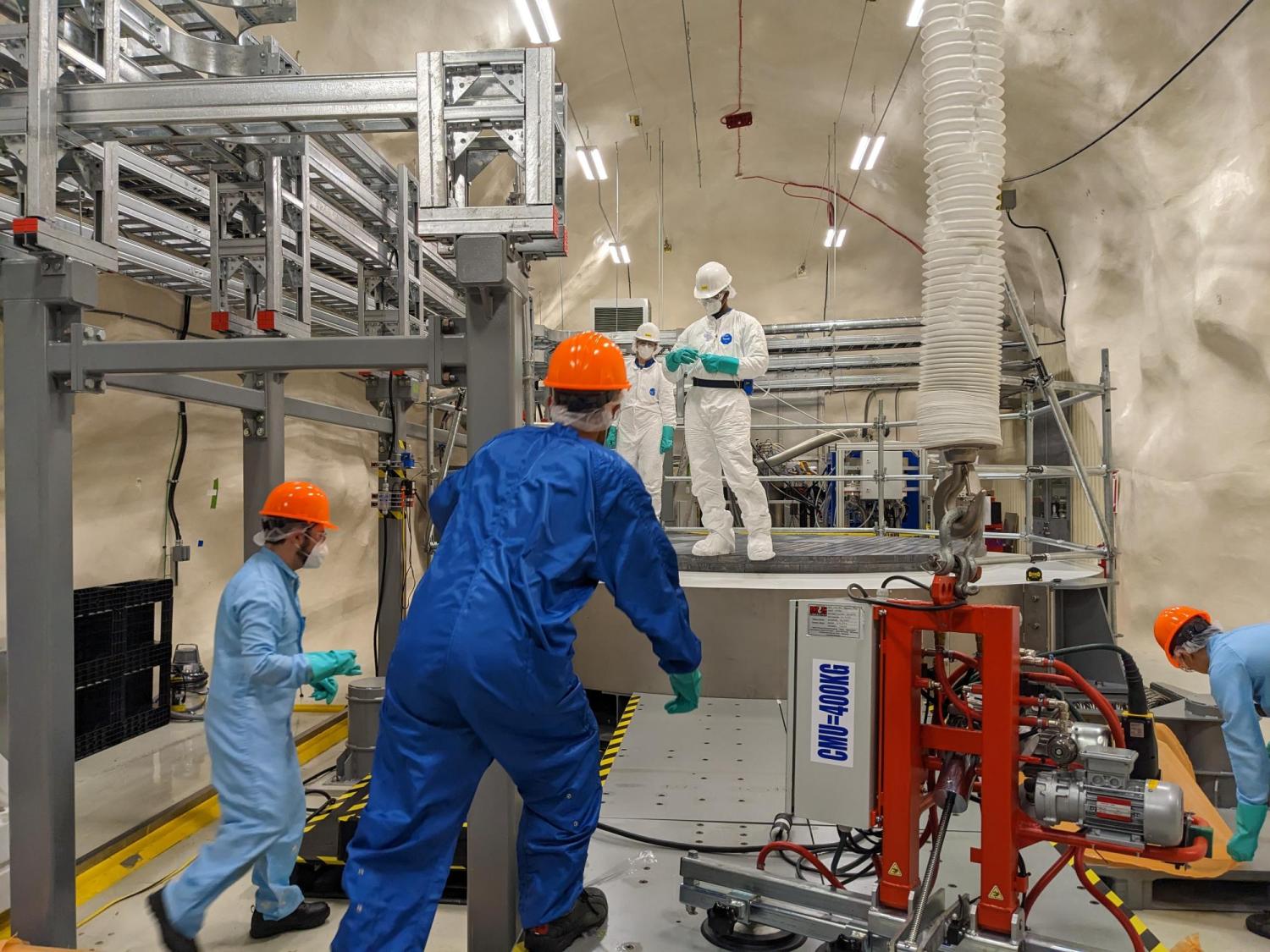
CU Denver physics faculty also support data analysis efforts and have participated in on-site work at the underground facility, including helping construct shielding systems critical to the experiment’s sensitivity.
They've played a central role in the SuperCDMS collaboration for more than two decades, leading the development and optimization of ultra-sensitive superconducting quantum interference device (SQUID) amplifiers—an enabling technology that converts faint signals from dark matter detectors into measurable data.
This work spans the design, characterization, and integration of these amplifiers with both cryogenic detector systems and room-temperature electronics, helping make the experiment’s precise measurements possible.
This is the nature of collaborative science. Each contribution builds toward a shared goal, advancing knowledge through collective expertise.
That progression reflects how momentum builds in research. Incremental advances, collaboration across institutions, and long-term investment all leading to a moment where discovery becomes possible.
“It’s a huge milestone. But in a way, the work has just begun.”
—Anthony Villano

Amy Roberts works on equipment in SuperCDMS lab.
What Comes Next
With detectors now operating at near absolute zero, the experiment is entering its first data-taking phase.
For CU Denver researchers, the next steps focus on applying calibration methods in real conditions and comparing those results to years of simulations. This includes preparing controlled neutron-based tests to validate detector performance without interfering with other sensitive experiments in the shared underground lab. As data begins to flow, CU Denver faculty will continue contributing to analysis and refinement efforts across the collaboration.
At CU Denver, research is not isolated from the classroom or the community. It is part of a broader ecosystem where faculty, students, and partners work together to move ideas forward. Participation in collaborations like SuperCDMS reflects the strength of that approach. By contributing to global research initiatives, CU Denver helps drive discovery while creating opportunities for learning, engagement, and impact.
This is how momentum builds. Step by step. Contribution by contribution. And now, with the experiment underway, that momentum is accelerating toward discovery.