
For the second year in a row, a CU Denver chemistry professor has claimed Colorado's top chemistry honor. 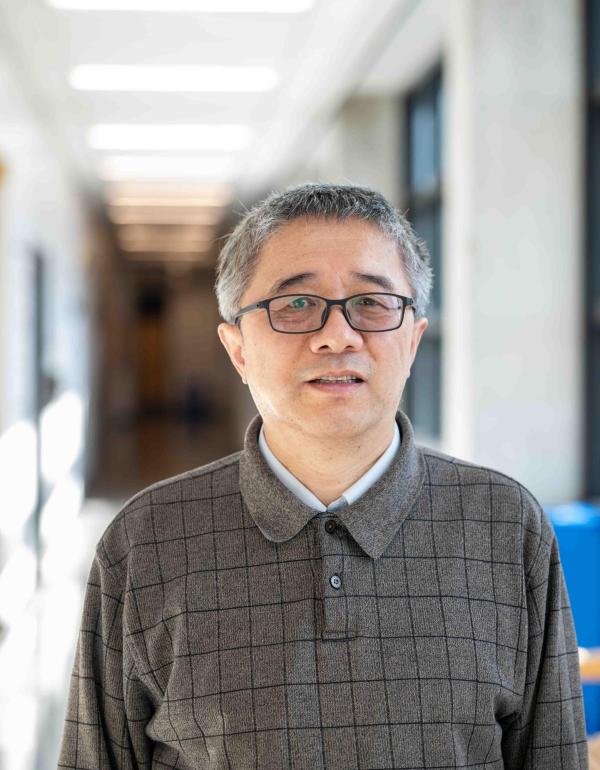
In 2018, zero students were enrolled in CU Denver's biochemistry program. Today there are more than 400 - and the professor who built it happens to be among the top 2% of most-cited scientists in the world.
His name is Haobin Wang. This spring, the Chemistry Professor and Associate Chair was named the recipient of the 2026 American Chemical Society Colorado Section Award, the second consecutive year the honor has come to CU Denver.
Established in 1967, the ACS Colorado Section Award honors individuals who have made significant advancements in research, education, and service to the chemistry community in the state. It is among the most prestigious recognitions available to a chemist working in Colorado.
"This department is quite strong in computational chemistry," Wang said. "We are very competitive in this subfield within the state of Colorado."
"We offer excellent opportunities for students who study here."
A Researcher Who Stays Curious
Wang's field is theoretical and computational chemistry - the science of modeling how molecules behave at the quantum level. A 2025 report by Stanford University and Elsevier placed him among the top 2% of most-cited scientists in the world. It's a striking number, but Wang himself is more interested in talking about what drives the work than cataloguing its accolades.
His path to the field wasn't predetermined. It was during graduate school at Wayne State University in Detroit, working under computational chemistry pioneer Bill Hase, that things clicked.
"It was actually much later than people might expect," Wang recalled. "It was during my first or second year there that I decided I wanted to be a theoretical chemist like him."
Building a Department, One Student at a Time
For seven years - two full terms from 2014 to 2021 - Wang also served as department chair, a role he took on without stepping back from his research. One of his signature achievements was launching a bachelor's degree in biochemistry, a program that went from zero students at its 2018 launch to more than 400 today.
"Obviously, I'm very proud to see those students coming out of the program, but I cannot take full credit for that," Wang said, quick to name former Associate Chair Scott Reed and Biochemistry Program Director Jeff Knight. "We established a program to serve the needs of students trying to be the next generation of scientists or those preparing for medical school."
Today, CU Denver's Chemistry Department counts 14 tenured or tenure-track faculty - nearly all of whom hold at least one external research grant, a notable distinction for a department of its size.
Making Science Feel Possible
Wang is direct about something that a lot of professors won't say out loud: when students struggle with chemistry or math, it's not always on the student.
"Science and mathematics are evolving, and teaching practices are evolving as well," he said. "As faculty, we should encourage students to learn math within a specific context - background knowledge is very important."
He also sees a rethinking of math education as overdue. The machine learning era, he argues, opens up new ways to make quantitative thinking feel relevant and rewarding. "There is a lot of practical mathematics we can teach to make the practice more interesting for students," he said.
That philosophy shapes how he describes CU Denver to prospective students. "We are a small department, but the faculty's research is very competitive. Because we are smaller, the faculty is very heavily involved in both research and teaching. We offer excellent opportunities for students who study here."
"Teaching practices need to evolve too."
What the Award Means
Wang has been an ACS member for nearly 30 years. He served in New Mexico before joining CU Denver, and currently holds a council seat in the Colorado Section.
For a scientist who has spent decades pushing the boundaries of quantum simulation while building one of the fastest-growing chemistry programs in the state, the recognition feels, in his own words, straightforward: "This department is quite strong."