
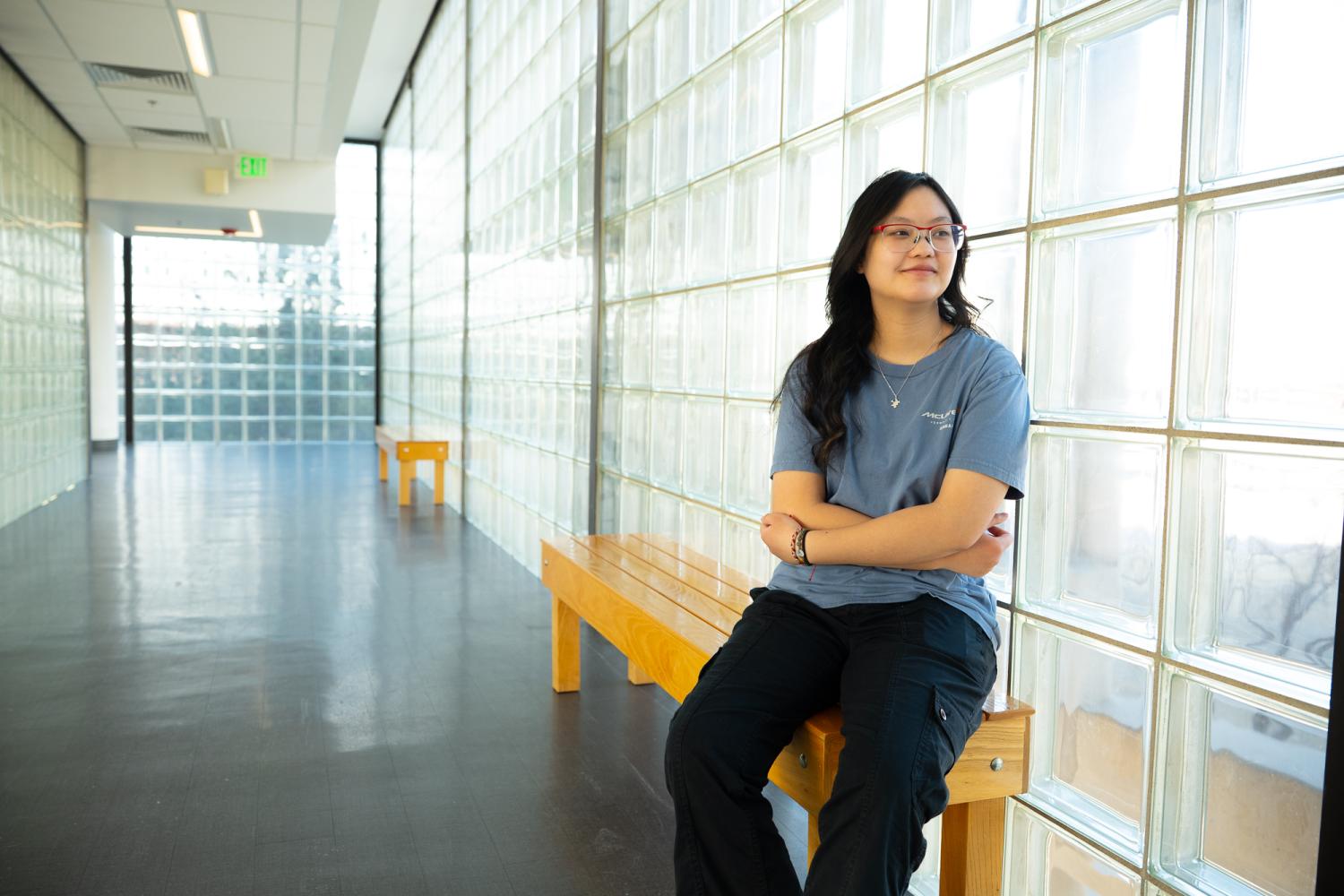
Abby Epstein rests in the North Classroom building hallway where many of her classes are held.
Explore the Bachelor of Applied Science Program
Three nights a week, Abby Epstein moves between worlds.
In the morning and early afternoon, she’s on the Auraria Campus taking classes at the University of Colorado Denver. By late afternoon, she’s back at Arapahoe Community College, where her automotive cohort meets from 5 to 9 p.m. By the time she heads home, most people are long done with their workday.
“It’s been a lot already this semester,” she said. “I’m there Monday through Wednesday from 5 to 9. And I have classes from 8 to 2:30.”
It’s a demanding schedule. But Abby has always preferred motion to stillness.
“I prefer doing hands-on stuff,” she said. “Just anything that would get me out of a desk. I really don’t want to work a desk job when I’m older.
She’s finishing an associate of applied science degree in automotive service technology, and her favorite classes are electrical. “It’s just something I’ve always been interested in—just how circuits work,” she explained.
“Growing up, I had this toy called Snap Circuits… it’s just something I find fun to do.”
Cars came naturally. Motorsport followed. A few years ago, she started watching Formula One and found herself hooked. “I’ve always loved cars,” she said. “And I started watching Formula One a couple years ago. And I just got really into it.” Driving at that level isn’t realistic—“I would have had to start when I was eight”—but working behind the scenes is. “Probably more like behind the scenes of all of it. Working for a team or the media team—just anything behind the scenes.”
Formula One is global, fast-paced, technical, strategic.
It’s engineering and communication and culture colliding at 200 miles per hour. Abby understands that if she wants to enter that world, she needs more than an associates of applied science degree. She needs to build something broader—without losing what she’s already earned. That’s where the Bachelor of Applied Science came in.
Not Starting Over—Building Forward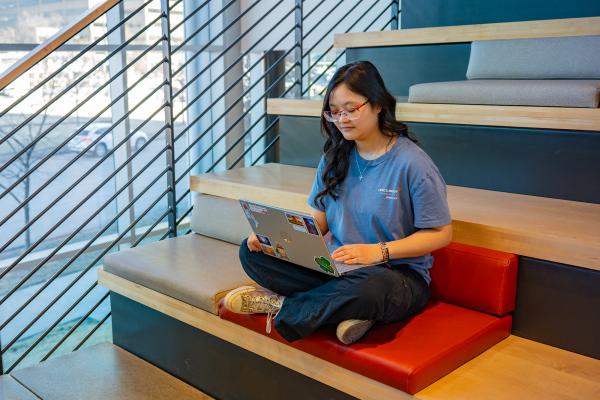
Abby’s dad found the Bachelor of Applied Science (BAS) in Professional Studies at CU Denver’s College of Liberal Arts and Sciences. At first, she was focused on finishing her associate degree. But she knew there was a looming problem.
“If I had finished [my associate degree], there really wasn’t any way to apply it to another degree if I wanted to continue,” she said. “And with the BAS program, it allowed me to finish my automotive program and then still apply all that to the bachelor’s.”
For many students with an Associate of Applied Science (AAS), transferring can feel like erasing years of work. Paul Le, director of the BAS program, has seen it firsthand.
“There was a portion of these students who happened to have AAS degrees,” Paul explained. “And as you know, an AAS doesn’t transfer as well as an AA or an AS because they’re built as technical degrees.”
Students would open their degree audits and realize most of their credits didn’t apply. “So it was almost like starting over from scratch again,” he said. “Which is daunting to a student who’s already invested so much time.”
The BAS was designed specifically to solve that problem. The bachelor’s degree requires 120 credits; roughly 60 from an AAS can transfer in. “You can rest assured that you’re not going to lose anything,” Paul said. Even technical credits count toward the total.
For a student like Abby—direct, practical, intentional—that structure matters. It means she can finish what she started in automotive while layering in the broader skills she’ll need for an international motorsport career. She isn’t abandoning her foundation. She’s building on it.
Designing a Global Skill Set
Formula One isn’t just mechanical. It’s international. Teams span continents. Drivers and engineers represent dozens of nationalities. Media, sponsors, and fans are global. Abby knows that to work in that environment, she needs to think beyond the garage.
“I really want to go into Formula One… and it’s big on international,” she said. “So kind of orientating all my classes to international communications and stuff like that—just international stuff that would be kind of helpful to interact with people from other cultures.”
She plans to pursue a Strategic Communication certificate along with a global or intercultural pathway through the BAS. She’s even explored study abroad opportunities in China, Japan, and Korea, thinking carefully about how international experience could support her long-term goals.
One of the features that drew her to the BAS was flexibility.
“When they explained that we could change a bit of the certificates around, if need be, it was really nice to know,” Abby said. “It’s a little something that kind of drew me a little bit more towards the program.”
Paul Le, BAS Program Director
“We really try to hone in on what their goals are,” he said. “And then provide our own recommendations.”
Because while flexibility opens doors, it can also feel overwhelming. That’s why advising in the BAS is deeply personal.
“Since it’s such a flexible degree, we know that sometimes that flexibility can be daunting,” Paul said. “You really get individual advising almost. You’re still getting that small community feel at a university setting.”
Certificates are central to that design. Students complete two, and as soon as a certificate is finished, it appears on their transcript. “It’s not like you have to wait until you completely finish the BAS,” Paul said. That incremental progress can matter in fast-moving industries.
For Abby, it means every class is part of a strategy. Automotive knowledge gives her credibility. Strategic communication sharpens her voice. Global coursework expands her range.
Each piece connects.
Momentum in Motion
Abby’s path hasn’t been linear. Before automotive, she started in theater at Wichita State. She competed in SkillsUSA, advancing to nationals in leadership. She’s navigated construction, community college cohorts, and now overlapping coursework between two institutions. She has learned how to plan carefully—and how not to waste time.
Her advice to other community college students is straightforward: “Don’t waste any time on unnecessary classes. And then also make sure you pass your community classes first—the first time around instead of having to take them again.”
That mindset—efficient, deliberate, forward-looking—aligns perfectly with the BAS. Paul sees the excitement in that kind of student. “Every BAS student’s kind of on their own journey,” he said. “Every conversation is new.”
The program is still growing. New certificate pathways are emerging. Industry connections are expanding. Students are helping shape what it becomes.
For Abby, the appeal isn’t abstract branding. It’s practical momentum. She is not starting over. She is not abandoning the skills she has already built. She is accelerating—layering communication, global awareness, and leadership onto a technical foundation that began with circuits and engines. Formula One is fast. It’s competitive. It’s international. It rewards preparation. On long days that stretch from 8 a.m. to 9 p.m., Abby is preparing.
And at CU Denver, she’s not just earning a bachelor’s degree. She’s designing a trajectory.
 For Abby Epstein, the next pit stop is just part of the plan. Where's your next pit stop?
Upgrade your Associate of Applied Science degree into a Bachelor of Applied Science degree in Professional Studies with guided help from program coordinators.