
Karin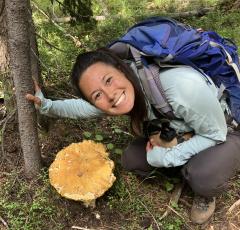 a Li
Master's Thesis Defense
Advisor: Dr. Diana Tomback
Date: November 12, 2026
Time: 10:00am – 11:00am
Location: North Classroom 1525
Clark’s nutcrackers (Nucifraga columbiana) in Yellowstone National Park: Regional Movements, Habitat Use, and Seed Resources
Whitebark pine (Pinus albicaulis) is declining across its range due to the compounding impacts of white pine blister rust, mountain pine beetle outbreaks, drought, and severe wildfire. As these declines progress, diminished cone production may alter the distribution of the pine’s primary seed disperser, the Clark’s nutcracker (Nucifraga columbiana), ultimately disrupting the mutualism between these two species. To better monitor these changes, we used Clark’s nutcracker point count and satellite-telemetry data to evaluate habitat use and large-scale movements in Yellowstone National Park (YNP). Forest community type and survey timing were the strongest predictors of Clark’s nutcracker abundance. Highest abundances occurred in limber pine (Pinus flexilis) and whitebark pine communities during September when seeds were ripe for both conifers. Telemetry data revealed that nutcrackers required expansive and, in some cases, multiple annual home ranges distributed across neighboring regions in Montana and Wyoming and used in consecutive years. While the distance and direction of long-distance movements between home ranges were highly variable, emigration consistently initiated in mid-June, with individuals settling in winter ranges by mid-September (n = 8). Based on these results, we suggest that Clark’s nutcrackers in YNP can readily be counted in whitebark and limber pine habitat in September. However, counts conducted earlier in summer could result in unexplained variance (overdispersion) and violation of the superpopulation closure assumption, demonstrating how standard protocols designed for seasonal migrants may fail to capture abundance trends for species with atypical life histories.