

Summary
Teeming with life from all trophic levels, seagrass grows in vast meadows from 1 to 58 meters deep in salty and brackish waters along the coast where different species of seagrass are found pole to pole along all continents except Antarctica (Reynolds, 2018). Seagrass meadows play a huge role in carbon sequestration, provide habitat for rich biodiversity, and structurally aid in defense against coastal erosion (Axtell, 2022). While they tick off plenty of boxes in terms of hyper-productive ecosystems making them incredibly valuable, they are unfortunately diminishing from environmental and anthropogenic factors. There has been a 29% decline in seagrass beds (Daidu et al, 2019), and efforts to remediate coastal habitats are trailing because our aquatic landscapes are not as well understood as our terrestrial landscapes (Lotze, 2021). Among the many hydrological conservation efforts that tackle climate change, planting seagrass beds is an impactful option because of its highly efficient carbon sequestration capabilities and its widespread ecological benefits. However, it is still a work in progress and requires further research to generate successful and large-scale seagrass meadow replanting efforts (Unsworth et. al., 2019).
Climate Change & Ecology 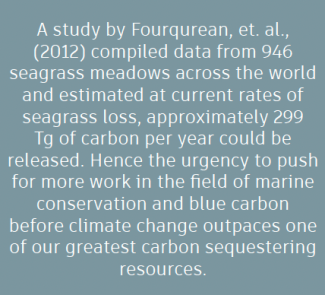
Seagrass is not seaweed (which is a type of algae), it is a vascular plant, part of the monocotyledon family along with lilies and palms. Like its terrestrial plant family in its structure, it has roots, rhizomes, and uses its green leaves with chloroplasts to convert sunlight into energy (Reynolds, 2018). Because seagrasses photosynthesize, they need to be in shallower waters within reach of sunlight. As greenhouse gases drive climate change and disrupt ecosystems (Turner et al, 2020), protecting and planting more seagrass meadows is strong approach to mitigating climate change because of their powerful carbon sequestration abilities and auxiliary benefits of housing biodiversity and protecting coastlines.
However, while seagrass may be one of our strongest tools against climate change, these precious meadows - and other marine habitats - are struggling under the pressures of climate change, such as from heat waves (Duarte, 2013). Changes in ocean chemistry and temperature from climate change will negatively affect the physiology of the plants and their distribution (Short, 1999). Reckless and insensitive natural resource extraction, invasive species, and destruction of habitat to make room for more anthropogenic land use are the overarching causes of seagrass meadow loss (Nichols et al, 2019).
 Biodiversity
 Biodiversity
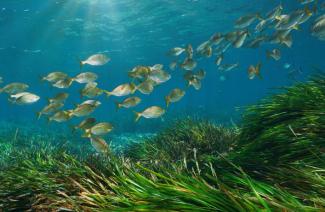
Seagrass supports such vast biodiversity because it is used for both habitat and food. The structure of the meadows is the perfect hiding place for prey, nurseries for juveniles of different species, and a stable diet for aquatic herbivores (Bertelli and Unsworth, 2014). There are a variety of herbivores that feed on seagrass, from dugongs to sea turtles to sea urchins, that graze as they move about. Other species, sessile invertebrates, are very small and attach to the leaves of the seagrass where they eat via filtering particles around them (Marine Education Society of Australia). Another way seagrasses feed the ocean is when bits get ripped off and float away, they eventually sink to the bottom and feed benthic organisms (Pawson, 2014). Sharks and bigger fish feed on the animals that feed on seagrass, thus populating the productive biodiversity of seagrass meadows with a variety of species that live there. Because there are so many relationships maintained in this habitat, it is that much more important to protect these aquatic landscapes. Should any one trophic level or the seagrass itself struggle, the others will unravel with it.

Bertelli & Unsworth, 2014
Coastal Protection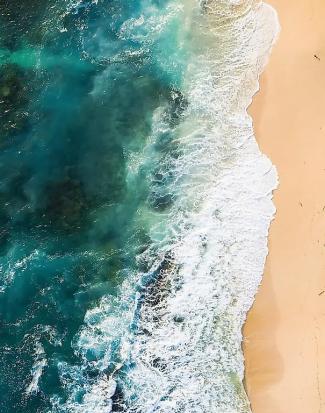
Seagrasse meadows are dense enough that they slow down water movement and stabilize soil, making them structurally beneficial to protect coastlines from erosion that occus from regular waves to storm runoff (Chen et. al., 2022). Because of seagrass’s shape, structure, and density, it can reduce wave intensity by dissipation, redirecting flow, and via friction (Duarte, 2013). One source of seagrass meadow decline that contributes to weakened coastal protection comes from inland activity. Resource extraction and geologic disturbances that reach moving water eventually washes out into an estuary where sediment, nutrients, and pollution are expelled into the coast (Daidu et. al., 2019). This mix of abiotic and biotic factors that overwhelm coastal habitats result in loss of seagrass meadows, making our coastlines vulnerable.
As there is a significant benefit in working with ecological engineering, more studies have been conducted on the hydrodynamics of waves and seagrass meadows. Chen et al (2022) used opensource coastal morphodynamical modeling software, Xbeach, to look at wave energy dissipation and sediment erosion and transport, under variables from mellower waves to a full storm. Chen’s results indicated that ‘green nourishment’ (seagrass plantings with shoreface nourishment) offers a viable solution to coastline protection by improving wave dissipation and sediment transportation. Understanding how these meadows buffer aquatic forces helps reinforce the motive to protect existing and replant new meadows.

kids.frontiersin.org
Carbon Sequestration
The major benefit of seagrass meadows in regard to climate change is they are extremely effective in sequestering carbon as a result of their biomass. Often dubbed as ‘blue carbon’, the carbon that is found in bodies of water can also be trapped and held in sinks much like a terrestrial forest (Fourqurean, 2013). While seagrass canopies cover about 0.1% of the ocean floor, they are accountable for 10-18% of carbon sequestration in the ocean which is incredibly efficient (WWF). Not only does seagrass take carbon into its tissues, it puts it into the soil it grows on; an approximation of carbon sequestration in seagrass is 140 Mg organic carbon per hectare in the top 1 meter of soil (Serrano et al, 2021). Researcher Marianne Holmer from University of Southern Denmark ranked the top 5 most efficient ecosystems for carbon storage, in order from most to least efficient is: tundra, seagrass, mangrove forests, salt marshes, and tropical forests (Svennevig, 2018). Ranked number two in her findings, that’s a significant status for an ecosystem to sustain. In this tug of war between accumulating greenhouse gases and environmental solutions, it drives the argument that conservation efforts ought to be a high priority. With that, successful conservation requires deeper knowledge.

whoi.edu
Research
Only 7.66% of the oceans are protected, and the Global Ocean Alliance set their goal for 30% by 2030 (Lotze, 2021). An ambitious but necessary goal, and another reason why investing and pursuing research in marine landscape conservation techniques is critical. Since there are over 72 species of seagrass and their habitats are found all over the world (Reynolds, 2018), there are many variables at different scales for their success, leaving us without a one-size-fits-all guide on how to rear successful seagrass meadows. Through studying seagrasses by region, analyzing previous studies, and advancing what we know about planting technique and reproductive schedule, we can rebuild lost meadows and prevent future fragmentation of current meadows. The following are case studies in seagrass meadow research.
Regional Survey
Tan, YM., et. al. (2020) did a broad survey of current seagrass restoration in Australia and New Zealand. The paper looks at existing gaps in seagrass restoration knowledge, species specific studies, ecological engineering, upscaling restoration trials, collaboration between entities, and long-term monitoring plans. It was mentioned that as seagrass meadow restoration projects expand, there will be a transitional phase from research to maintenance. As a study grows (physically in scale), it becomes more work to maintain so it is important to promote collaboration between scientists and external entities who will become the future guardians of these seagrass meadows so that the longevity of these restored seagrass meadows is ensured. Tan, YM. (2020) lists gaps in our knowledge of seagrass restoration (plantings) from the research: resourcing and responsibility for maintaining seagrass meadows, seagrass species reproductive biology, developing tools to identify target sites for replanting, spatial and genetic connectivity, provenance and distribution, understanding of tropical species (more research has been done on temperate and subtropical species of seagrass), upscaling restoration trials, ecological engineering, and long-term monitoring of meadows.

Tan, YM., et al. (2020)
Planting Technique
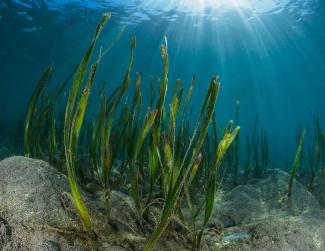
Unsworth’s (2019) team observed the seeds do not have the opportunity to take root in some areas due to greater tidal movements or heavy seed-predation. They started a method called ‘BoSSLine’ (Bags of Seagrass Seeds Line) by filling a hessian bag with a mix of seagrass seed and sediment and anchoring it to the ocean floor. The organic material of the hessian bag breaks down over time allowing the germinated seedlings to take root. They tested their product and technique in North Wales and Cornwall, in Britain. The experiment yielded promising result however they acknowledge a need for further research in seagrass germination because of low viability.

Unsworth et al (2019)
 Planting Schedule
 Planting Schedule
Technique is one variable, knowing when to plant seagrass is another. Seagrass replanting schedules have been studied in Sweden since their coastline is subjected to harsher environments from high-latitude characteristics such as ice formation, low light exposure, and short-growing seasons (Infantes et al, 2021). A study by Infantes et al (2021) in Sweden looked at how to store the seeds in a laboratory so they could be planted right before germination and immediately start growing. Since no one had done it before on the Scandinavian timeline of seagrass growth cycles, Infantes’ research was launched to determine how seeds should be stored in laboratories until it was their time to be planted, what were the causes of seed loss, what season to plant the seeds for optimal seed succession, and best planting methods. While the study made headway with timing and seasonality, Infantes noted more work needed to be done to address seed loss once they were planted.

Infantes et al (2021)
Learning from the Past
In a study done in Florida, USA by Rezek et al., (2019), they examined 33 different restored seagrass beds from 3-32 years old that had been understudied and compared them to contemporary more-referenced restored seagrass beds. The study compared: percent ground cover, species diversity, and community structure (other species living in the meadows). In their discussion, the findings showed the understudied restored meadows were 37% lower in data sets than the higher-referenced seagrass restored meadows. This means the more studied meadows have demonstrated how accumulated knowledge of seagrass biology and ecology give them a more competitive edge in survival and establishment. Rezek speaks to the benefits of comparing seagrass restoration studies to identify gaps in knowledge and continue moving forward expanding our knowledge of seagrass restoration. Rezek’s study also identifies the most common obstacle in restoration is getting the meadows past the early stages when the seeds and saplings are most vulnerable.
From Research to Application
In the UK, 20% of seagrass beds found in NW Europe are in Scotland and like many other regions, Scotland’s seagrass bed decline (Scotland’s Nature Agency). Its neighbor, Wales, had success with a seagrass restoration project and Scotland has picked up the efforts as well. A handbook ‘Scotland’s First Seagrass Restoration Guide’ was put together for Scotland by a joint effort from Marine Scotland and Project Seagrass. The handbook is a work in progress as every region and underwater site can differ, however the more it is used and put into practice, the more knowledge can be added to it for future restoration projects (Scotland’s Nature Agency).

Discussion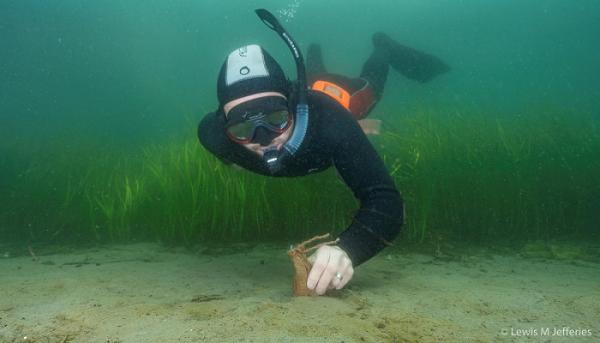
While humans don’t take to water like a duck, we sustain ourselves from its nutritious aquaculture, build our dwellings along its picturesque coastlines, recreate in its shores, and breathe clean air filtered by aquatic vegetation. Seagrass meadows shoulder many ecological responsibilities and, as the data presents, are a major player in carbon sequestration. Another critical motive for seagrass restoration efforts is its adjacencies to other habitats that it supports. For example,seagrass and coral reefs trap sediments together resulting in clearer water around mangrove forests and estuaries to allow for better photosynthesis (Vozzo et al, 2023). Seagrass restoration has been going on since early 2000, however consistency and depth in the field hasn’t kept up with the severity of seagrass meadow loss and climate change (van Katwijk et al, 2015). Given the highly efficient carbon sequestering abilities of seagrass and its vulnerability as oceans warm and their levels rise, continuing to support research in seagrass restoration efforts ought to be a high priority on a global scale.
blogs.gov.scot
Rachel Thody is a current dual Master of Landscape Architecture and Master of Environmental Science student.