
Introduction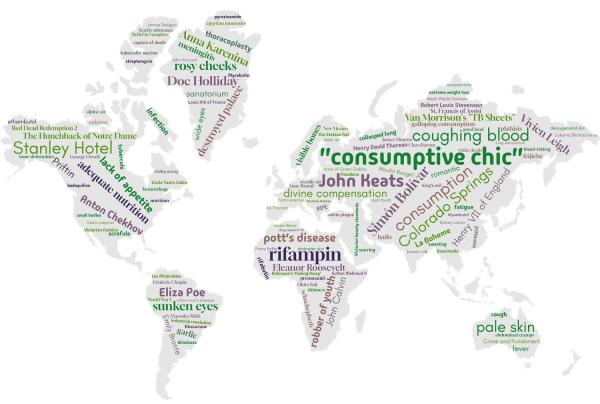
Tuberculosis is an ancient disease. Possible marks of the disease were found in a 500,000-year-old hominid fossil in Turkey in 2007 (University of Texas), and evidence of tuberculosis has been found in mummies all over the world, such as Peru (1000 years ago), Egypt (4000+ years ago), and the eastern Mediterranean (8000-10000 years ago). It’s had many names (consumption, white plague, phthisis, the king’s evil, lungexhaustion) and has been the cause of death of many of the world’s most famouspeople, from US presidents (James Monroe and Andrew Jackson) to authors andartists (such as George Orwell, the Bronte sisters, Anton Chekov, Ralph WaldoEmerson, John Keats, and Sidney Lanier) to kings and rulers (such as Henry VII of England, Louis XIII of France, and Sultan Mahmud II of the Ottomans). Whole cities were founded at least in part as tuberculosis sanctuaries (Colorado Springs, CO; Pasadena, CA; and Asheville, NC), and tuberculosis either inspired or played a crucial role in many cultural works, particularly in the 19 th century. Examples range from the novels “Crime and Punishment” and “Uncle Tom’s Cabin”, the musical “Moulin Rouge!”, the video game “Red Dead Redemption 2”, and Van Morrison’s song “TBsheets.”
It’s estimated that 25% of all deaths in Europe between 1600-1800s can be attributed to tuberculosis with a similar proportion in the United States (Centers for Disease Control). Significant decreases in mortality due to tuberculosis began with Dr. Robert Koch’s discovery of the bacteria that caused tuberculosis in 1882, for which he won the 1905 Nobel Prize in Medicine and Physiology.
The global tuberculosis mortality rate lingers around 17 deaths per 100,000 people, with tuberculosis killing around 1.2 million people in 2023. Around 60% ofthese deaths occurred in Asia. Adjusted for population, however, tuberculosis was much more deadly in Africa. The average mortality rate from tuberculosis in African countries as 38 per 100,000 persons—more than 3x higher than Asia’s rate of 12 per 100,000 persons. In 2023, the mortality rate from tuberculosis in the Central African Republic was 142 per 100,000 persons and was the second highest in the world; in contrast, the same rate for the United States was 0.2 deaths per 100,000 persons. For an American audience, it may be useful to look at the mortality rate of COVID-19 during the height of the pandemic for a comparison. The highest mortality rate for COVID-19 in any continental US State was Oklahoma in 2021, with a rate of 158.8 per 100,000 persons.
COVID-19 briefly eclipsed tuberculosis as the world’s deadliest infectious disease during that period, though by 2023, tuberculosis had retaken its crown. The World Health Organization (WHO) declared COVID-19 a pandemic in March of 2020. With a global push towards combating and eradicating the disease, vaccine development began immediately, with widespread rollout within a year and a half. By 2022, COVID-19 mortality rates in the United States had plummeted, even in the states that were worst affected. Oklahoma, for example, had a mortality rate of 71.9 per 100,000 persons by 2022.
Treatments and prevention for tuberculosis does not need to be developed from scratch. The Bacille Calmette-Guérin (BCG) vaccine was developed in the 1920s to prevent the disease, and antibiotics were discovered in the 1940s and 1950s to treatthe disease. In 1900, the mortality rate in the United States was 194 per 100,000 persons; by 1995, the mortality rate had dropped to an astonishing 8.7 per 100,000 persons.
There are many factors that increase the risk of death due to tuberculosis. People living with HIV have a much higher risk of developing active tuberculosis compared to those who do not live with HIV because HIV weakens a person’s immune system, thus also weakening the body’s ability to combat tuberculosis bacteria effectively. In 2023, an astounding 81% of new tuberculosis cases occurred in people who had already been diagnosed with HIV (WHO). In six countries, that percentage is over 70% and is largely concentrated in Sub-Saharan Africa.
Chronic malnutrition can also compromise the body’s immune defenses, making individuals without tuberculosis much more susceptible to infections and reducing the body’s ability to combat the illness naturally once they are infected. To exacerbate matters, many tuberculosis drugs are notoriously nauseating, a situation that can be made worse by taking the medication on an empty stomach. Since tuberculosis treatment spans many months, these unpleasant effects—along with other challenges—may lead patients to discontinue their regimen, leading to increased drug resistance.
When someone receives a positive tuberculosis diagnosis, treatment typically consists of a course of various antibiotics for at least 3 or 4 months, but can be 24 months or more. Patients usually begin with what are known as first-line drugs, which are older and less toxic medications. These include streptomycin, rifampicin, isoniazid, pyrazinamide, and ethambutol. Second-line drugs are used when first-line treatments are not effective or when significant drug resistance is detected, and are newer, more expensive, and often more toxic. These include fluoroquinolones and bedaquiline, linezolid, and a host of injectable agents such as amikacin, capreomycin, and kanamycin.
In many places where tuberculosis is rampant, a system called DOTS (directly observed short-term treatment) is in place. In this system, a patient with TB often has to visit a health clinic every day to be observed taking their cocktail of TB drugs. The social stigma of tuberculosis, the transportation cost to get to the clinic, and the distance of the clinic from a patient's home can make adherence to DOTS can bedifficult in many parts of the world. These difficulties, as well as horrendous side-effects and supply chain disruptions, all contribute to patients halting or pausing their treatment, which leads to increasingly more cases of drug-resistant TB.
When resistance to isoniazid and rifampicin (the most common and effective first-line drugs) is detected, tuberculosis is called "multidrug-resistant tuberculosis" or MDR-TB. When resistance to both of these drugs and at least one variety of fluoroquinolone, as well as either to a second-line injectable, bedaquiline, or linezoidis detected, tuberculosis is called “extensively drug-resistant tuberculosis” or XDR-TB. This variety of tuberculosis is extremely difficult to treat.
Drug resistance is not only a problem for countries with high levels of TB incidence. In 2023, Kazakhstan had 14,000 new cases of all TB in 2023 and 1,496 new cases of MDR-TB (WHO, 2025), which meant around 10% of the cases in that country were resistant to the most effective first-line treatment that year.
Dr. Peter Mugyenyi once spoke of HIV, saying that the drugs are where the disease is not, and the disease is where the drugs are not. This is true of tuberculosis diagnosis tools, drugs, and treatments today. Most of the places that most need tuberculosis care have limited access to it, largely due to funds or supply-chain issues. Many of the diagnostic tests that can detect whether a patient has tuberculosis, as well as which strains they might be resistant to, are much more expensive than a simple test that says whether or not they have been infected at all. Many of the second-line tuberculosis drugs are for many of the countries most afflicted with tuberculosis burdens due to cost.
It’s estimated that an “as-usual” scenario between 2020 and 2050 would result in 31.8 million deaths, resulting in an economic loss of 17.5 trillion dollars (Cox & Furin,2021). An “as usual” scenario may be preferable to what is happening now; global tuberculosis mortality rates have been on the rise since 2020, including in the United States.
In early 2025, President Trump’s administration cut more than 80% of USAID’s funding, devastating international foreign aid and development assistance. USAID is the third largest tuberculosis research funder, as well as being critical to tuberculosis prevention, treatment, and testing worldwide. Dr Tereza Kasaeva, Director of WHO’s Global Programme on TB and Lung Health, says, “Any disruption to TB services –whether financial, political or operational – can have devastating and often fatal consequences for millions worldwide.” Due to the cuts, millions of people have had their treatment paused or delayed—something detrimental to the already worrying drug-resistance issue.
This atlas aims to provide a comprehensive overview of the global landscape of tuberculosis, highlighting the areas where the disease is most prevalent. By visually mapping a few key risk factors—such as HIV/TB incidence and malnutrition—it seeks to illustrate some of the causes that contribute to higher rates of exposure and infection. It also examines the distribution and evolution of drug-resistant tuberculosis, offering insights and warnings for the world in the years ahead.


Lauren Parkinson is a current Master of Arts student in the Department of Geography & Environmental Science.