
There is a quiet resistance to the idea of global interconnectedness. Not because it is difficult to understand, but because it is difficult to accept. It suggests that even the smallest actions are never isolated; they extend outward, accumulate, and alter conditions elsewhere. What we eat, how we move, and where we spend are not neutral decisions but actions embedded within systems that distribute power, access, and consequence. To acknowledge this is to admit that we are never outside of these systems but always implicated within them. If every action is already entangled, then what, exactly, makes a place? Not just where we are, but what gives that location meaning. Place does not sit still long enough to be defined cleanly; it is formed through relationships that are constantly shifting, layered, and contested. Place, then, is not a thing but an ongoing production shaped by social relations, uneven power, and movement across space. This relational understanding of place can be visualized as the overlap between structural forces, social relations, and spatial form.
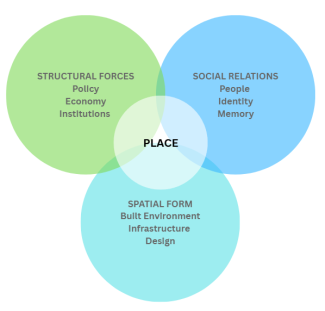
Figure 1. Author’s relational model of place, illustrating how structural forces, social relations, and spatial form intersect to produce place. The model builds on relational theories of place and place attachment, particularly the idea that place emerges through material conditions, social relations, and meaning-making processes (Diener and Hagen 174).
Place vs. Space
The distinction between space and place marks a starting point. Space is abstract, a field of coordinates, while place is lived and experienced. It gathers meaning through memory, repetition, and interaction. David Seamon’s concept of “place-ballets” describes how everyday routines—walking the same route, recognizing familiar faces, moving through shared rhythms—produce a sense of familiarity and belonging. Over time, these patterns stabilize meaning and anchor individuals to place.
Yet repetition alone is insufficient to explain place. Allan Pred argues that places are never complete or stable but are continuously produced through the interaction between structural forces—such as economic systems, governance, and institutions—and individual agency. Edward Relph extends this by focusing on attachment, suggesting that to be “inside” a place is to identify with it, while “existential outsideness” reflects alienation and disconnection. Place, therefore, emerges through tension between repetition and change, belonging and distance, and structure and agency.
Time–Space Compression and Globalization
Globalization intensifies these dynamics by compressing distance and accelerating connection. Doreen Massey’s concept of time–space compression captures how technological and economic shifts make distant places feel closer. However, Massey emphasizes that this process is uneven, shaped by what she terms “power geometry.” Some individuals and groups control flows of capital, information, and mobility, while others are constrained by them.
This unevenness reshapes place itself. Noel Castree argues that places are not bounded entities but open systems defined by connections that extend beyond their immediate boundaries. A neighborhood’s identity is therefore shaped not only by its physical environment but by supply chains, migration patterns, and policy decisions operating across multiple scales. Place becomes a node within broader networks rather than an isolated location.
As shown in Figure 2, Castree’s metaphors help clarify how place can appear bounded while still operating through wider networks of connection.
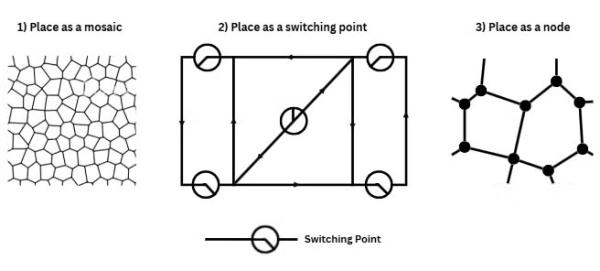
Figure 2. Castree’s metaphors for understanding place as a mosaic, a switching point, and a node. Models 2 and 3 illustrate place as both bounded and connected, supporting the idea that globalization and time–space compression produce places through networks of social relations (Castree 170).
Loss, Commodification, and Contestation
If place is produced through relationships, it can also be reorganized through power. Edward Relph’s concept of placelessness describes environments that have been standardized and stripped of distinctiveness. Increasingly, digital platforms such as Uber Eats and Airbnb reshape spatial experience by translating neighborhoods into zones of efficiency and consumption.
In this process, place is not erased but reformatted. It becomes measurable, searchable, and commodified. These transformations raise critical questions about power: who defines place, who benefits from its restructuring, and who is displaced. Place thus becomes a site of contestation where competing claims over meaning, access, and value intersect.
Toward a Relational Understanding of Place
A relational perspective reframes place as the intersection of social, material, and narrative processes. Doreen Massey argues that what gives a place its specificity is the unique configuration of relations that converge within it. Diener and Hagen similarly emphasize that place is shaped through material conditions, embodied practices, and narrative meaning. From this perspective, the distinction between local and global dissolves. A single location can simultaneously reflect intimate familiarity and distant connections. Place is not defined by scale but by the relationships that constitute it.
Conclusion
Place is not fixed but continuously assembled through interaction and shaped by forces that extend beyond immediate perception. To ask what makes a place is to ask how power moves through it—who belongs, who decides, and who is excluded. These dynamics are not stable; they shift as relationships shift.
The risk is not that place disappears but that its transformations go unrecognized. When place is treated as given, the systems producing it remain invisible. Place endures, but it does not remain the same.
Olivia Young is a recent graduate of the Bachelor of Arts in Geography program.