
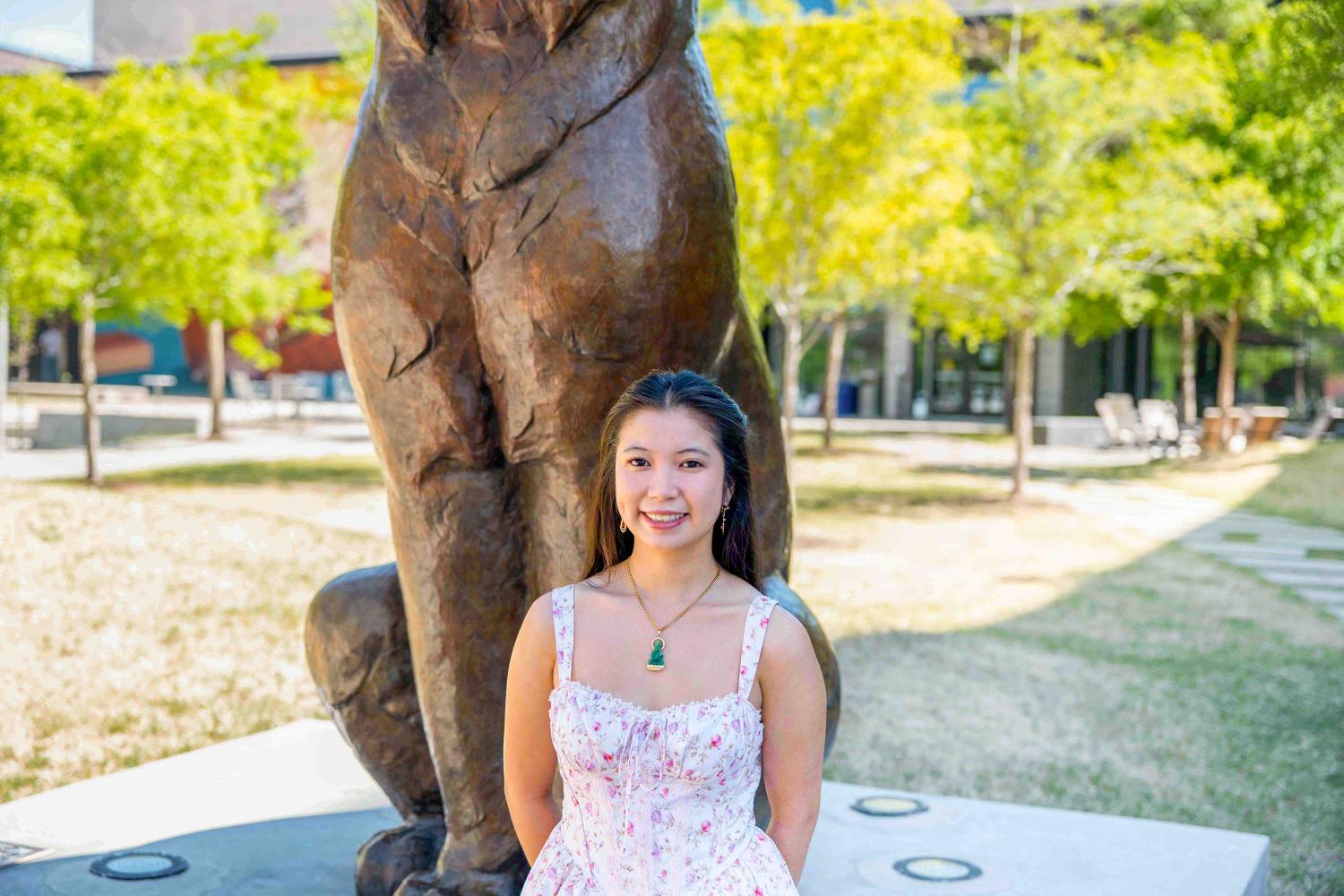
By the time Kim-Phung Van walks across the stage this May to receive her Bachelor of Science in Psychology from CU Denver, she will carry with her something no diploma can capture: the weight of stories that were deeply felt, but never spoken out loud.
"Growing up in a Vietnamese household, there's so much trauma, resilience, survival, grief — felt by people who didn't firsthand experience it," says Kimmy. "And there's so much lived experience that is left unheard."
That tension — between what is felt and what is spoken — has become the engine of her academic life.
Giving a Voice to the Data Points
Van's undergraduate research centers on intergenerational trauma in the Vietnamese American community, a subject that sits at the crossroads of the deeply personal and the scientifically urgent. It's a field where the need for rigorous research is matched only by the absence of it.
"Communities like mine are often underrepresented in research...And if they are talked about, they're reduced to data points or statistics. But there are so many stories left unheard."
For Kimmy, research is a form advocacy — a way of creating space for communities that have historically been pushed to the margins of both medicine and academia. Her work insists that science can be a vehicle for amplifying voices, not just analyzing them.
The Mountain and the Path
Finding her footing in higher education wasn't without its challenges. As the daughter of immigrants and refugees, Van was navigating terrain that felt entirely uncharted. "My parents came here with nothing to give me everything," she says. "Remembering that I have opportunities they never had is what keeps me going."
But she's quick to point out that momentum isn't just about personal drive — it's about community. Mentors, peers, siblings, and professors at CU Denver all played a role in making what felt unfamiliar feel possible.
She returns often to a quote that has guided her through the harder stretches: "There are many paths to the top of the mountain, but the view is always the same." Whether you're moving fast or slow, taking detours or doubling back, the destination remains. You're still going to get there.
Hear more of Kimmy's story
Building Belonging at CU Denver
As president of the Asian Student Association, Van channeled that same philosophy into community building on campus.
"You get out what you put in," she says. "And being here reminded me that well-being is deeply communal."
Under her leadership, the association became more than a cultural organization. It became a proof of concept for what belonging can look like. One person feeling supported creates a ripple. People feel seen, safe, and ultimately, like they matter.
And the door was always open. "You don't have to be Asian to attend," she notes. In the heart of Denver, surrounded by students from every background and identity, Kimmy built something intentionally wide.
Learn More about CU Denver's Asian Student Association
A New Model of Care
Now, as graduation approaches, Van is looking ahead to medical school and a career in medicine shaped by everything she's learned — in the classroom, in the lab, and in community. "I want to build a model of health care where patients feel understood before they feel treated."
It's a deceptively simple idea that cuts to the heart of what's broken in how medicine currently serves communities like hers. Too often, she says, patients face care that is inaccessible or culturally disconnected — barriers that have nothing to do with the illness itself and everything to do with how health care systems were built, and for whom.
"Health isn't just treating the illness," Van says. "It's deeply emotional, mental, spiritual, and cultural. I want to treat patients as people before their illness."
Giving Back
When asked for a parting thought, Van doesn't hesitate.
"Thank you so much to CU Denver for the most wonderful four years of my undergraduate career. I hope to keep making an impact and give back to the community — because it's given me so much."
For a student who came in carrying the unspoken stories of her family and her community, that feels exactly right. She didn't just find her momentum here. She found her purpose.