
Modernizing Biomolecular NMR at CU Denver: The POKY Suite Speeds Up Discovery
A research team at the University of Colorado Denver is helping scientists move faster from raw molecular data to real-world insight. In a new paper published in the Journal of Biological Chemistry, CU Denver researchers highlight the POKY suite, a software ecosystem that streamlines biomolecular Nuclear Magnetic Resonance (NMR) data analysis and brings more automation and AI into a workflow that has traditionally been slow and complex. In fact, many researchers often spend weeks manually identifying thousands of tiny “peaks” in the data, creating a major bottleneck in discovery.
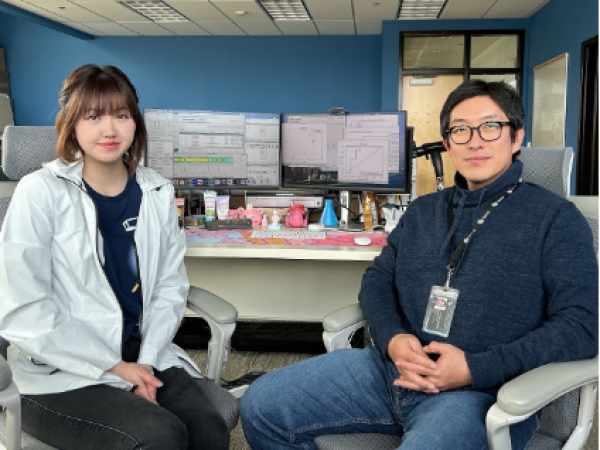
Led by PhD student Abigail Chiu and mentored by Assistant Professor Woonghee Lee, the paper outlines how POKY makes it easier to process NMR data, assign resonances, and support structure determination in one integrated environment—helping more labs access the power of structural biology. Their work brings modern computing directly into a field critical to medical innovation.
Why Protein Structure Matters
Proteins do the work of life, and their 3D structures help explain how they function—and how they sometimes malfunction in disease. When researchers can “see” a protein’s structure at the atomic level, they can better understand where a potential therapeutic might bind and how to design drugs that fit more precisely.
One of the most valuable tools for that kind of close-up view is biomolecular NMR spectroscopy. NMR can reveal atomic-level details about protein structure, dynamics, and interactions under near-physiological conditions. But the tradeoff has long been time: turning NMR spectra into reliable structural insight can require many steps, specialized expertise, and multiple disconnected software tools.
The Bottleneck: Complex, Fragmented NMR Workflows
For many researchers, the challenge isn’t collecting NMR data—it’s what comes next. Typical NMR analysis can involve:
- Processing raw time-domain data into spectra
- Finding and validating peaks
- Assigning those signals to specific atoms in a protein
- Feeding results into separate tools to calculate and validate 3D structures
Because these steps often occur across different platforms and file formats, they can slow progress and create unnecessary opportunities for error. That fragmentation can also raise the barrier to entry for new students and scientists learning the method.
How The POKY Suite Helps Researchers Move Faster
The POKY suite is designed as a single, user-friendly environment that connects the major steps of biomolecular NMR analysis. Rather than forcing researchers to stitch together separate programs, POKY integrates widely used tools and adds guided workflows and automation features that reduce manual effort.
According to the review, POKY supports work across the full arc of NMR analysis, including:
- Spectral processing and alignment tools
- Automated and guided resonance assignment pathways
- Structure calculation workflows that connect to server-based computing resources
- Options that support beginners through guided interfaces, and advanced users through scripting and notebook-based customization
AI Plus Experiments: A Practical “And,” Not An “Or”
As AI-based structure prediction tools continue to evolve, the role of experimental methods is shifting—but not disappearing. The review emphasizes that POKY helps create synergy between experimental NMR data and structure-prediction approaches, thereby supporting workflows in which computational models and experimental evidence reinforce one another.
That balance matters in real-world research: experiments can validate, refine, and add dynamic information that purely computational predictions may miss, while modern computation can reduce time and effort across routine analysis steps.
Real-World Impact: Making Structural Biology More Accessible
At CU Denver, research is built for impact—work that’s ambitious, grounded, and connected to real needs. Tools like POKY don’t just improve efficiency for experts. They help open doors for more students, early-career scientists, and interdisciplinary teams to use NMR in structural biology and related fields.
By lowering barriers and modernizing workflows, the POKY ecosystem supports a more accessible path to discovery—one that can accelerate researchers' learning from molecular structures and translate that knowledge into applications such as drug development and biomedical innovation.
Read the team's full paper here.