
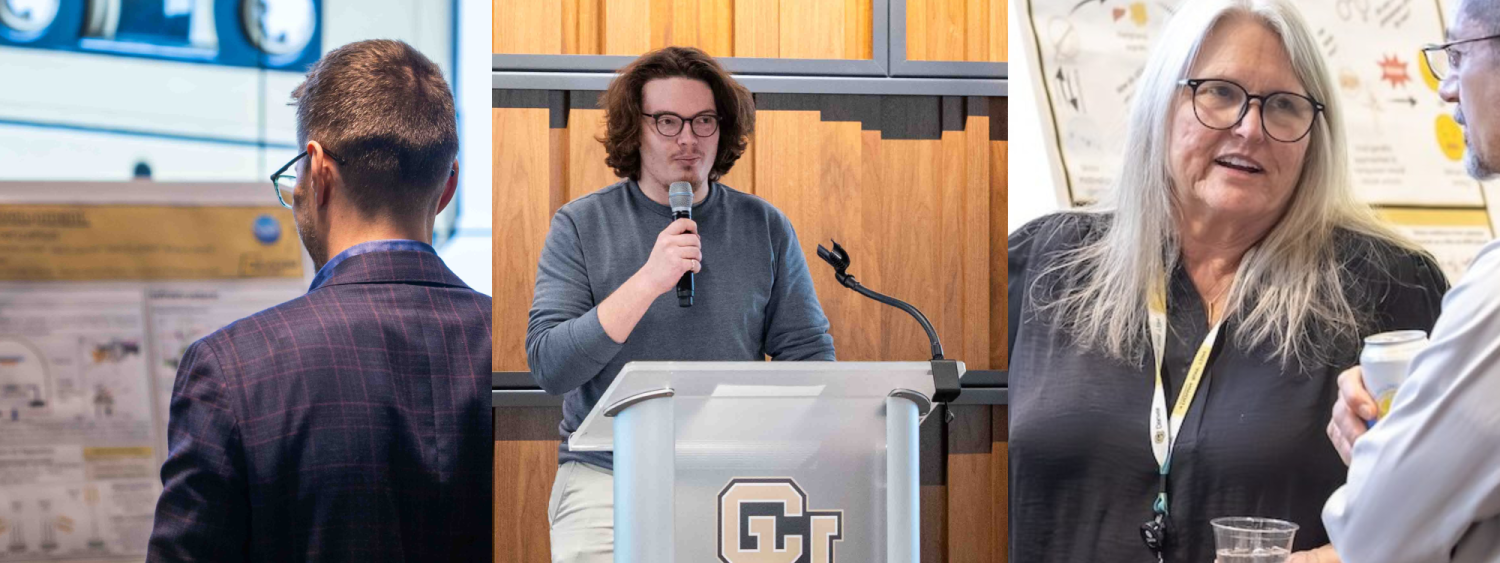
From left to right: Troy Butler views a research poster, Elias LaFord presents a poem, Laura Argys explains her work
On February 12th, the College of Liberal Arts and Sciences gathered faculty researchers for CLAS Mixtape, an event showcasing the diverse and impactful scholarship happening across the college. From the economics of outdoor recreation to the frontiers of quantum computing, from urban climate solutions to the lived experiences of undocumented students, the presentations revealed the breadth and depth of research shaping our understanding of the world. Four faculty members took the stage to share their work, each offering a unique perspective on how scholarship connects to the challenges and opportunities of contemporary life. Here are their stories.
Rachel Gross
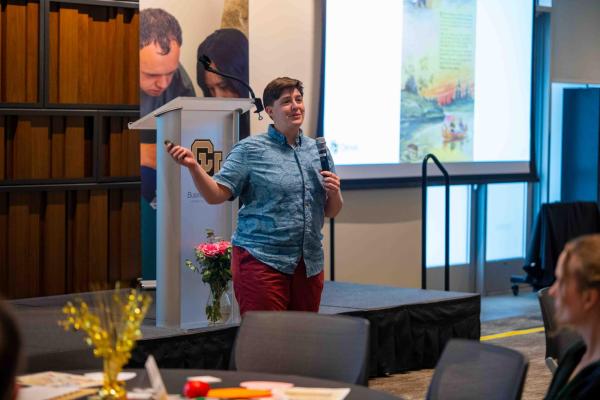 History
Rachel Gross transported us through time to explore how Americans fell in love with the outdoors—and opened their wallets in the process. The outdoor industry has ballooned from $800 billion pre-2020 to a staggering $1.2 trillion today, representing roughly 2% of GDP. But Gross's research asks a deeper question: how did wild spaces become essential to American identity? She traced this phenomenon back to the turn of the 20th century, when urban industrial workers began seeking masculine renewal and respite in nature, spurring consumption of outdoor gear that would reshape the retail landscape.
From Abercrombie & Fitch's origins as a premier outdoor outfitter to the Eddie Bauer-branded Ford Expeditions of the 1990s, Gross's work reveals that most outdoor product consumers are actually casual enthusiasts—people who love the idea of camping more than the practice itself. Her book, Shopping All the Way to the Woods: How the Outdoor Industry Sold Nature to America, examines this fascinating paradox: Americans who may never summit a mountain still define themselves through their outdoor purchases. Understanding this identity-driven consumption, Gross argues, is central to understanding the American outdoor experience itself.
Martin Huber 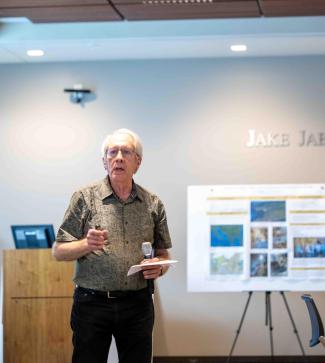
Natural Sciences
Martin Huber introduced us to the esoteric yet crucial world of quantum sensors, where measurements approach the fundamental limits of physics itself. At the heart of his work is the SQUID—Superconducting Quantum Interference Device—which Huber describes simply as a "quantum compass." Unlike the semiconductor electronics in our smartphones that operate at room temperature using classical physics, superconductive electronics exhibit quantum properties at macroscopic distances of inches and feet. This remarkable phenomenon, which earned three physicists the Nobel Prize for their 1980s experiments, enables precision and accuracy far beyond conventional electronics.
Huber's research has wide-ranging applications, from geophysics and medicine to dark matter experiments and materials research. Perhaps most excitingly, SQUIDs serve as building blocks for transmon qubits—a leading technology in quantum computing used by companies like Google. But Huber's impact extends beyond the laboratory. He's helped package decades of expertise into a quantum technology certificate program at CU Denver. Through collaborations with Elevate Quantum and Front Range Community College, the program is developing workforce training that will launch this summer, preparing the next generation of quantum technicians for this rapidly expanding field.
Edelina Burciaga
Ethnic Studies
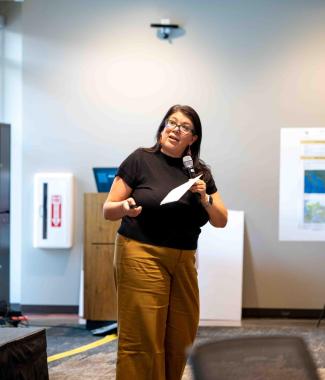
Edelina Burciaga posed a powerful question: what happens when your path to college—and therefore your future—is profoundly shaped by your immigration status and where you live? Her book, Life Undocumented: Latinx Youth Navigating a Place of Belonging, captures the contrasting stories of undocumented young adults in California, which provides legal pathways to higher education, and Georgia, which does not. Through compelling portraits, Burciaga reveals how "legal ecologies"—the intersection of federal, state, local, familial, and individual dynamics—shape both opportunities and sense of belonging.
Despite nearly 15 years documenting structural constraints, Burciaga's research also illuminates the resilience and agency of undocumented youth. While comprehensive immigration reform seems distant, she emphasizes that local institutions can make real differences. CU Denver already implements many best practices: training faculty and staff in key offices, securing internships that don't rely on legal status, providing robust financial support, offering trustworthy legal connections, and creating safe spaces where students can bring their whole selves. In the current climate of legal uncertainty, Burciaga argues, bold and innovative support at the institutional level isn't just helpful—it's crucial for ensuring educational success for all students.
Ben Crawford
Geography and Environmental Sciences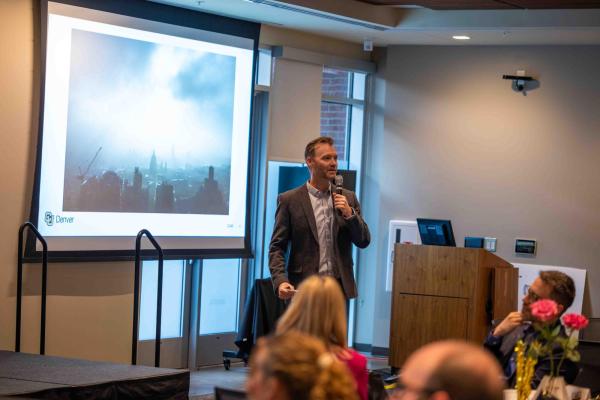
Ben Crawford reminded us that while we often think of "outdoors" as wilderness, most of us actually experience the outdoors in cities—and those urban environments create entirely novel climates. With over 90% of Americans and more than half the world's population now living in urban areas, Crawford's research on urban weather and climate has profound implications for billions of people. Cities replace natural materials with concrete, asphalt, and glass, creating engineered microclimates that are often hotter and more polluted than their surroundings. His observational approach uses sensor networks to measure what residents actually experience daily.
Crawford's work reveals surprising insights about urban heat. In Denver, he found that hotter areas green up sooner than cooler ones, and irrigated areas stay green longer—showing how humans directly influence vegetation, which in turn affects local climate. Another project examining heat at bus stops discovered that while objective temperature drives how hot people feel, thermal comfort depends more on perceptions of cleanliness, aesthetics, and safety. Looking forward, Crawford sees tremendous opportunity: over 60% of areas forecast to become urban haven't been built yet. This means we have a chance to redesign cities as climate refuges—comfortable, healthy, pleasant places to live as our climate continues to change.