
When we talk about health, it’s easy to focus on individual choices or genetics. But where people live, learn, work, and move through daily life can be just as powerful. That’s the lens at the center of An Introduction to the Geography of Health (Third Edition), co-authored by Peter Anthamatten, associate professor of Geography and Environmental Science at the University of Colorado Denver, and Helen Hazen, teaching professor at the University of Denver.
Published by Routledge, the updated edition shows how geographic perspectives help explain health and disease by connecting environmental conditions and social circumstances with human well-being.
A Practical Guide To Understanding Health, Place, And Power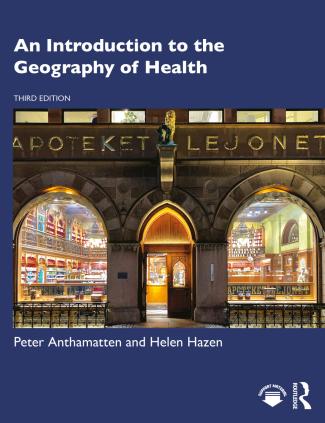
Health geography asks clear, real-world questions that students and communities care about:
- Why do some neighborhoods face higher exposure to pollution, heat, or flooding?
- How do housing, transportation, or access to healthcare shape health outcomes over time?
- What happens when misinformation spreads faster than public health resources can respond?
Designed as a core textbook for undergraduate and lower-level graduate courses, the book blends engaging case studies with methods and theory, emphasizing that theory matters most when it helps solve real problems.
New and expanded sections include:
- Mental health
- PFAS (“forever chemicals”)
- Climate change
- Coercive pronatalism
- Health misinformation
- Updated content reflecting the impacts of the COVID-19 pandemic
These additions reflect a fast-changing world where health is shaped by both ecological conditions and social systems, from environmental exposure to policy decisions and cultural context.
Research And Learning With Real-World Tools: CU Denver’s GAMLab
Anthamatten also directs CU Denver’s Geospatial Analysis and Mapping Laboratory (GAMLab), a CLAS-based geospatial service center that supports research through Geographic Information Science and Technology. The GAMLab helps CU Denver faculty and students visualize, explore, and analyze human-environment challenges using mapping, visualization, and spatial analysis, while also facilitating collaboration across academic, government, private, and community partners.