
Explore CU Denver's Mathematical and Statistical Sciences Graduate Programs
The CU Denver PhD graduate is using spatial statistics research to help communities identify disease hotspots faster and more effectively.
When Kayley Smiley arrived at CU Denver during the height of the COVID-19 pandemic, she had never stepped foot on campus.
Like many graduate students starting college in 2020, her introduction to the university happened entirely online. Faculty members rolled laptops through hallways during virtual visits. Future classmates met over Zoom instead of coffee.
Still, something about CU Denver felt right.
“It just felt like home,” Smiley said.
Originally from Southern California, Smiley moved to Denver after earning her undergraduate degree at California Baptist University. She and her husband, who also studied mathematics, applied to graduate programs across the country hoping to find a place where they could both continue their education.
CU Denver stood out immediately.
Even during a global pandemic, Smiley said the Department of Mathematical and Statistical Sciences created a sense of connection and support that was impossible to ignore.
“The community was just excellent,” she said. “People were encouraging and there to get through this together, not competing against each other.”
That leap of faith led Smiley to discover a research path that would shape her future.
Finding Purpose in Applied Mathematics
Smiley always knew she loved math. What she did not know was how many directions the field could take her. “I had no clue what field I wanted to end up in,” she said.
At CU Denver, she explored different areas of applied mathematics before taking a spatial data analysis course with Professor Joshua French, PhD. The class introduced her to spatial statistics, a field that combines mathematics, geography, and data analysis to study patterns tied to location.
The course changed everything.
“You couldn’t help but pay attention,” Smiley said of French’s teaching style. “It was fascinating.”
As Smiley worked more closely with French through an independent study, she became especially interested in disease hotspot analysis. The research focuses on identifying geographic areas where disease rates are unusually high, helping researchers and public health officials better understand environmental risks and direct resources where they are needed most. For Smiley, the work felt deeply meaningful.
“I could see this helping the community,” she said. “I think that helps when you can picture exactly how this would help people.”
Research With Real-World Impact
During her doctoral research, Smiley focused on improving existing methods used to identify disease hotspots. One major challenge in the field involves accounting for additional variables like age while analyzing disease patterns. For example, cancer rates are naturally higher in older populations, but many existing models struggle to efficiently include that type of information.
Smiley and her advisor developed a faster computational method that dramatically improved the process. The existing method took approximately seven hours to analyze one dataset. Their updated approach reduced that time to just 15 minutes.
“That’s a big difference,” Smiley said.
The improvement could help epidemiologists and public health researchers use hotspot analysis more regularly in real-world settings. Smiley’s work will also become part of a research package, making the method more accessible to researchers across the field.
“It feels very rewarding,” she said. “This could really practically help a community.”
The project also reinforced one of the biggest lessons Smiley hopes future students understand about mathematics.
“There’s so much you can do with it,” she said.
Building Confidence Through Community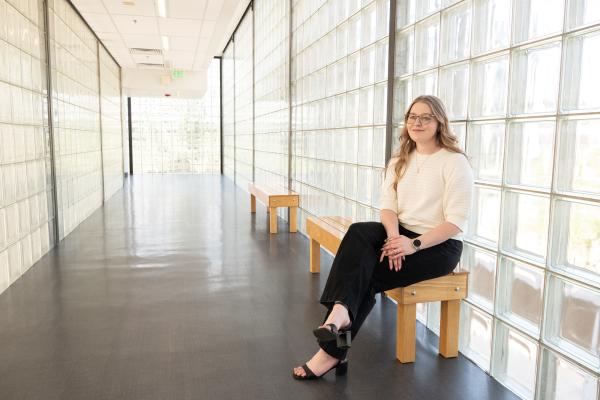
Graduate school was not always easy. Smiley openly shares that she failed both of her preliminary PhD exams the first time she took them. Those moments tested her confidence and left her questioning whether she belonged in the program.
“They definitely gave you a bit of imposter syndrome,” she said.
Instead of giving up, Smiley leaned on the community she built within her cohort. Together, classmates studied for exams, supported one another through setbacks, and celebrated milestones along the way. “I really depended on those people, and they depended on me,” she said.
That support system became one of the most important parts of her CU Denver experience.
“I would say, really find a community and lean into it,” Smiley said. “On your tough days, they’re there to listen, and on your good days, they’re there to celebrate with you.”
Today, she hopes being transparent about her struggles helps other students realize setbacks do not define their future. “I got less than a 10% on my first preliminary exam as a grad student, and then I passed the next time,” she said. “It happens to everyone.”
Using Data to Serve the Community
While completing her PhD, Smiley also worked full time for the Denver Auditor’s Office, where she applies data analysis and statistical methods to support government accountability and efficiency. The role allowed her to connect her classroom learning directly to public service work.
“I get to use everything that I learned in the PhD program,” she said.
Now, after graduating, Smiley plans to continue publishing research from her dissertation while building her career in data analytics and public sector work. Her journey reflects the flexibility and real-world impact of an applied mathematics degree.
At CU Denver, she found not only a research specialty but also the confidence to turn her skills into meaningful change.
Smiley encourages students interested in STEM, mathematics, or graduate school to stay persistent, especially when challenges arise.
Her advice:
- Find a supportive community and lean into it.
- Do not let failure define your abilities.
- Stay open to discovering new interests within your field.
- Ask professors questions and pursue research opportunities.
- Remember that mathematics can lead to careers far beyond the classroom.
“You’re going to go through tough times where you question where you’re at,” Smiley said. “For me, it was really just persistence and leaning into the people around me.”
What Can You Do with This Degree?
A degree in applied mathematics or statistical sciences can prepare students for careers across industries, including:
- Data analytics
- Public health and epidemiology
- Government and policy analysis
- Financial analytics
- Artificial intelligence and machine learning
- Geographic information systems (GIS)
- Research and higher education
- Environmental analysis
- Business intelligence
Students in CU Denver’s mathematical and statistical sciences programs gain workforce-ready skills in data analysis, statistical modeling, coding, research, and problem-solving. Many students also participate in hands-on research and collaborative projects that prepare them for graduate study and careers in fast-growing fields.
Explore CU Denver's Mathematical and Statistical Sciences Graduate Programs