
CU Denver faculty are helping shape what's next in biomolecular research. Woonghee Lee, PhD, assistant professor in the Department of Chemistry in the College of Liberal Arts and Sciences (CLAS), delivered a keynote address at the Turkish BioMolecular NMR 2026 Meeting, a newly launched conference focused on Nuclear Magnetic Resonance (NMR) spectroscopy in Turkey.
The conference took place April 20 through 23, 2026, at Founder’s Hall at Koç University in Istanbul and brought together researchers advancing NMR spectroscopy and structural biology.
A Global Stage for CU Denver Research
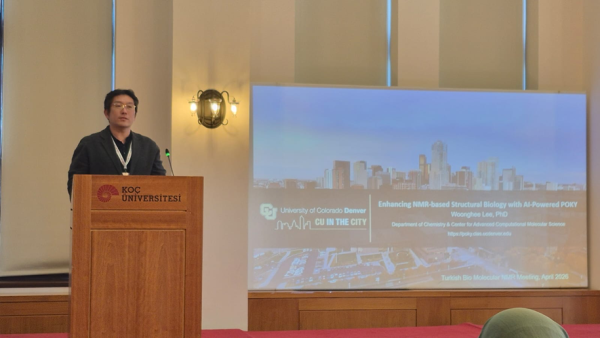
NMR spectroscopy is often described as "MRI for molecules." It's a powerful tool scientists use to understand how proteins are built and how they move, down to the atomic level. That kind of insight can help researchers better understand the biology behind health and disease, and it supports discoveries that matter in the real world.
In his keynote lecture, "Enhancing NMR-Based Structural Biology with AI-Powered POKY," Lee shared recent progress in AI-augmented approaches that help researchers do more with NMR data. His work centers on POKY, a software platform that supports biomolecular NMR research and has become widely used across the NMR community.
How AI Helps Scientists See More in NMR Data
NMR data can be complex and time-intensive to interpret. Lee's keynote focused on how AI-powered methods can strengthen NMR-based structural biology by improving how researchers process and analyze information.
In practical terms, AI-assisted tools can help research teams:
- Speed up parts of the NMR workflow
- Improve consistency in analysis
- Support deeper understanding of protein structure and dynamics
This kind of innovation reflects CU Denver's strength as a place where ambitious ideas meet real-world problem solving-and where faculty build tools that advance entire research fields.
NSF-Funded Research and International Collaboration
Lee is the Principal Investigator of the National Science Foundation-funded project, "Artificial Intelligence–Assisted Integrative Biomolecular NMR Platform." He also leads the U.S. side of a joint NSF–TÜBİTAK bilateral research collaboration titled "Characterization of the Interaction Mechanism of the C Lobe Region of Bi Functional HERC5 HECT Ligase via NMR Spectroscopy: Investigating Ubiquitin and ISG15 Interactions and Oligomerization Dynamics."
The Turkish counterpart of the collaboration is led by Çağdaş Dağ, PhD, of Koç University.
Together, this work highlights the value of international research partnerships—and how CU Denver faculty contribute to science that crosses borders, builds community, and drives impact.
Why This Matters for Students and the CU Denver Community
When CU Denver researchers share their work on global stages, it creates momentum that benefits students, colleagues, and partners at home and abroad. It also reinforces what makes CU Denver distinctive: accessible excellence, forward-thinking research, and collaboration that connects people to real outcomes.
For students exploring chemistry, biochemistry, data science, or biomedical research, Lee’s work is a reminder that innovation isn’t abstract—it’s built by people in labs, with tools and ideas that accelerate discovery and make it more inclusive for the scientific community.