
Packed room. Big questions. Real support.
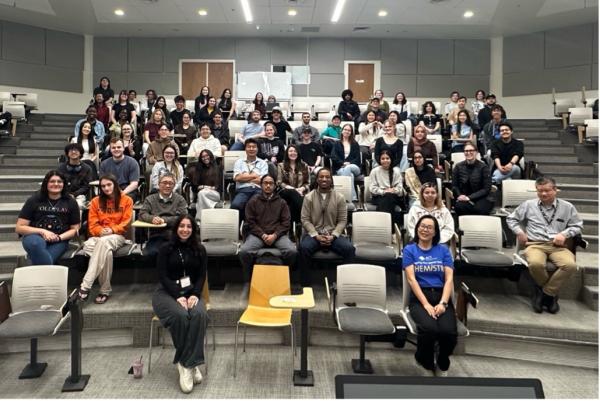
On March 18, 2026, the CU Denver Chemistry Club hosted The Math Roadmap: Cracking the Chemistry Code, a hands-on workshop designed to help students strengthen math skills that power success in chemistry. With 76 students attending, the space filled quickly with conversation, snacks, and the kind of focused energy that shows up when people feel like they belong and can ask honest questions.
Study Habits That Stick
The evening opened with a practical session led by Zeyna Aouad and staff from CU Denver’s Learning Resource Center (LRC). They shared quick strategies students can use right away to build stronger study routines, including structuring time, practicing consistently, and studying with intention.
Their message was simple and student-centered: success in science is built through steady habits, and those habits are learnable.
How Math Shows Up Across Chemistry
A panel of four CU Denver chemistry faculty members brought the topic to life by connecting math to the real work students do in different chemistry courses and fields. Instead of treating math as a gatekeeper, they framed it as a tool students can learn to use with confidence.
General Chemistry
Dr. Emilie Guidez began by offering approachable ways to tackle the mathematical components of General Chemistry. She also reflected on her own journey in learning math over time, from an undergraduate student to a computational chemistry professor.
Organic Chemistry
Dr. Jung Jae Lee encouraged students to move beyond memorization. He described Organic Chemistry as a visual, conceptual language rooted in 3D spatial reasoning and “electron pushing.”
Biochemistry
Dr. Kyoung Nan Kim highlighted how chemistry “comes to life” in Biochemistry through the math of biological pathways, with a focus on understanding and applying enzyme kinetics.
Physical Chemistry
Dr. Haobin Wang addressed the big topics head-on: calculus, differential equations, and statistics. He explained how these subjects "are not obstacles, but essential tools for understanding how chemical reactions unfold in real-world systems."
Community, Connection, And What Comes Next
The workshop ended with a dinner where students connected with faculty, asked follow-up questions, and won prizes. More than anything, the night reinforced a message CU Denver students know well: you don’t have to figure it out alone.
Chemistry can be challenging. The math can feel like a lot. But when students have access to clear guidance, supportive campus resources, and a community that wants them to succeed, tough concepts become manageable, and momentum follows.