
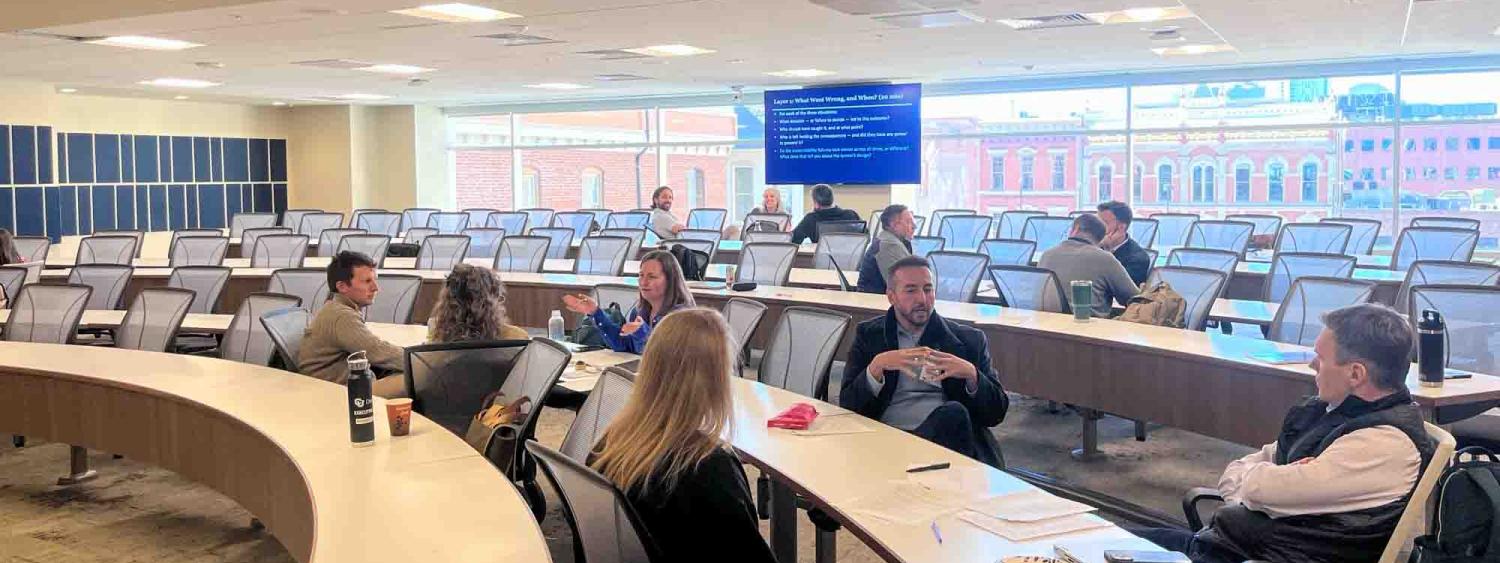
On March 20–21, 2026, the Executive MBA program at the University of Colorado Denver Business School hosted a two-day seminar on artificial intelligence, ethics, and organizational adaptation. Directed by David Chandler and Bethany Cape, the program regularly convenes seminars on pressing issues that fall outside the traditional curriculum, bringing together current students and alumni from across industries for intensive, discussion-driven examination of the challenges facing organizations today.
The seminar was designed and led by Professor David Hildebrand of the CU Denver Philosophy Department. It proceeded from a clear conviction: that the ethical questions raised by AI are not abstract — they are already present in the decisions organizations make about how to deploy, govern, and answer for these systems. Philosophy, accordingly, was not the focus of the seminar for its own sake, but applied in direct service of problems the participants already recognized in their professional lives.
"We had space to discuss AI in a nuanced way without an executive in the room insisting we all adopt it and love it."
- Jessie Moog, current EMBA student
Day One: The Human Stakes of AI
The first day addressed autonomy, privacy, surveillance, algorithmic opacity, and the erosion of meaningful accountability. A recurring theme was that AI does not introduce entirely new ethical problems — it dramatically amplifies existing ones. The afternoon turned to human dignity and the ethics of care — asking what is lost, and what must be protected, when AI mediates relationships that once required human judgment and presence.
Anh Thu Nguyen, a people experience leader at Trimble, joined the seminar to share her organization's experience with AI transformation and a recent AI coaching pilot, offering a candid account of the challenges and choices involved in responsible implementation.
"She had obvious real world experience with the topic at hand and gave good, relevant information on AI transformation"
- Dan Trujillo, CU Denver alumni
Day Two: Organizational and Systemic Adaptation
The second day moved to organizational and systemic questions: bias and structural fairness, distributed moral responsibility, and the risks of value drift as organizations adopt AI at scale. Ryan Jolicoeur, Director of Risk Analytics and Modeling at Charles Schwab, described how regulated industries navigate the tension between AI's analytical power and the demands of accountability, auditability, and trust — reinforcing the seminar's central argument that AI governance is not primarily a technical problem, but an institutional and ethical one.
Both days included substantial group work in which participants applied the seminar's frameworks to layered, realistic cases. The discussions drew visibly on the depth and diversity of the room: participants brought experience in defense, financial services, healthcare, technology, and management consulting, among other fields, and they applied the ethical concepts at hand, not as exercises but as live instruments for thinking through genuine dilemmas.
"A great approach to using ethics principles to frame AI topics — AI does not introduce new ethical issues, it just dramatically ramps up existing ones."
- Jessie Moog, current EMBA student
The closing session invited participants to reflect on what they would carry back to their organizations — a fitting practical conclusion to two days of inquiry that aimed, from the start, to demonstrate the value of ethical thinking in helping managers tackle contemporary issues.